Last update
2025
Summary
A linking canal with a lock, constructed in 1994, restored the hydrological connection between Srebarna Lake and the Danube, enabling an annual inflow of river water and preventing the lake’s isolation that began in 1949. This intervention improved water levels, reduced eutrophication trends and supported the recovery of biodiversity, notably the Dalmatian pelican colony. The site, inscribed on the UNESCO World Heritage List, is managed by the Ministry of Environment and Water through the Regional Inspectorate (RIEW) in Ruse, and has been part of Natura 2000 since 2008, with a 673-ha buffer zone.
Recent UNESCO reporting (2024) confirmed the site’s official area at 638 ha after correcting a cartographic error from 2007. Management faces new challenges: predation of pelican eggs by invasive raccoon dogs and, more rarely, golden jackals, sometimes facilitated by late ice formation after mild winters. These factors have prompted measures such as protective fencing around nesting sites. The hydrological system and monitoring remain essential to maintain ecological values, while updated management planning and maintenance of hydraulic structures are priorities for sustaining the lake’s ecological health.
Recent UNESCO reporting (2024) confirmed the site’s official area at 638 ha after correcting a cartographic error from 2007. Management faces new challenges: predation of pelican eggs by invasive raccoon dogs and, more rarely, golden jackals, sometimes facilitated by late ice formation after mild winters. These factors have prompted measures such as protective fencing around nesting sites. The hydrological system and monitoring remain essential to maintain ecological values, while updated management planning and maintenance of hydraulic structures are priorities for sustaining the lake’s ecological health.
Position
Latitude
44.10972
Longitude
27.07305
Project
NWRM
National Id
Bulgaria_09
Installation date
1994
Implementation Status
Contact
REC
RBD code
BG1000
Transboundary
0
Photo gallery
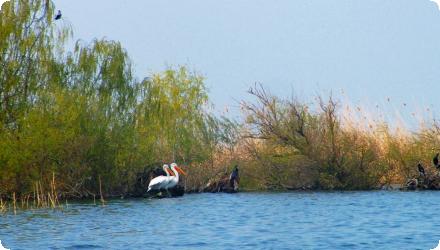
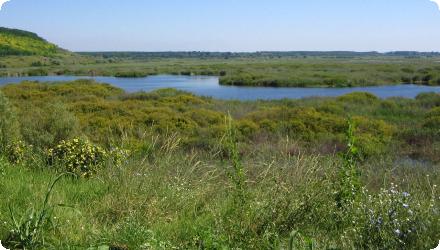
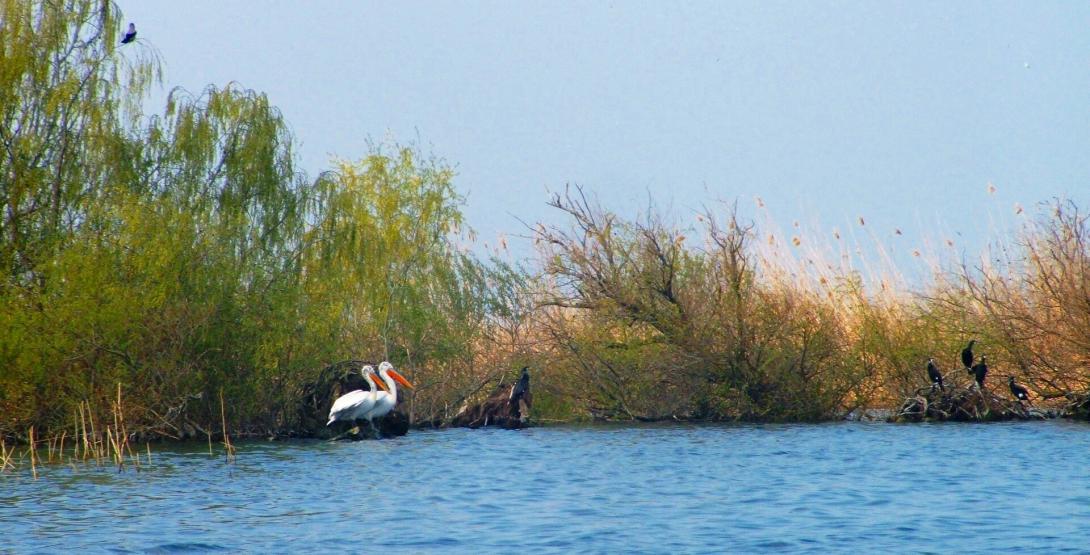
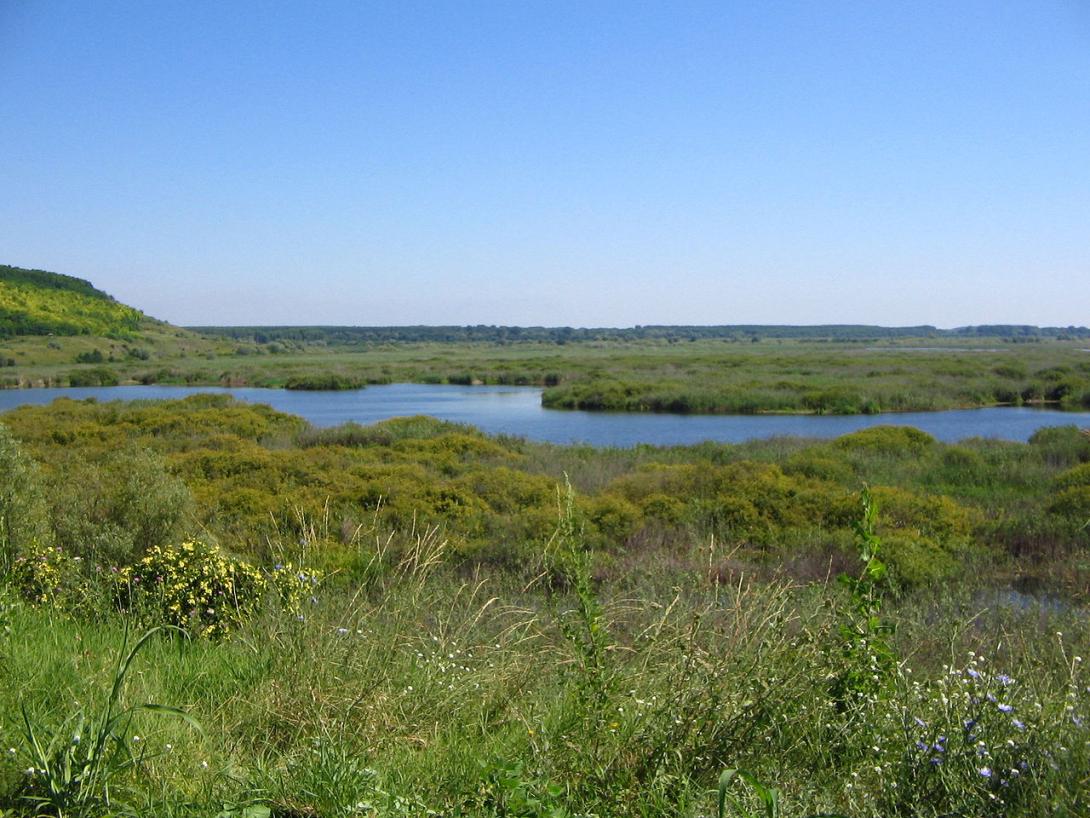
Location of the project
The Srebarna Nature Reserve is located in north-eastern Bulgaria, on the right bank of the Danube River, about 2 km south of the river’s main channel and roughly 18 km west of the city of Silistra, near the village of Srebarna (Vetren). It lies along European route E70/Silistra–Ruse road. The site covers 638 ha, with a 673-ha buffer zone, and borders Romania across the Danube.
NUTS Code
BG32 - Северен централен (Severen tsentralen)
Project's objectives
Restore hydrological connection between Srebarna Lake and the Danube River through a controlled inflow, reversing the isolation caused by the 1949 dike.
Stabilise and raise water levels in the lake to support wetland ecological functions.
Reduce eutrophication by flushing the lake annually with Danube water, thereby improving water quality.
Enhance biodiversity, with a focus on maintaining and increasing populations of key wetland species such as the Dalmatian pelican (Pelecanus crispus).
Comply with international commitments under the Ramsar Convention and later UNESCO World Heritage requirements, by halting ecological degradation.
Stabilise and raise water levels in the lake to support wetland ecological functions.
Reduce eutrophication by flushing the lake annually with Danube water, thereby improving water quality.
Enhance biodiversity, with a focus on maintaining and increasing populations of key wetland species such as the Dalmatian pelican (Pelecanus crispus).
Comply with international commitments under the Ramsar Convention and later UNESCO World Heritage requirements, by halting ecological degradation.
Involved Partners
| Authority type | Authority name | Role | Comments |
|---|---|---|---|
Climate zone
warm temperate dry
Temperature
12,8
Precipitation
547
Annual rainfall range
300 - 600 mm
Imperviousness
0,2
Imperviousness range
20 - 40%
Elevation range
11
Slope range
0.02
Vegetation class
The reserve is dominated by extensive reed beds (Phragmites australis) and other emergent aquatic vegetation, with associated wet meadow and aquatic plant communities.
Water bodies: Ecological Status
Poor
Water bodies: Chemical Status
Good
Water quality status
A 2025 DEIMS site description notes recent shifts towards strong eutrophication and accelerated vegetation succession, partly linked to changes in Danube connection and groundwater use in the catchment.
Project scale
Micro
Project scale specification
It involves a single, clearly defined site (638 ha lake and wetland, plus 673 ha buffer zone) on the right bank of the Danube, near the village of Srebarna. The intervention - construction and operation of a linking canal with a sluice (1994) - is a localised hydromorphological measure aimed at restoring water exchange between the lake and the Danube, improving ecological conditions within the reserve. While it benefits biodiversity of regional significance, its direct management and operations occur entirely at the site level.
Performance timescale
5 - 10 years
Project area
60200
Size
638
Size unit
ha
Interrupted connection with Danube River, Distance fom the main river
Designated to Strict nature reserve
Total cost
unknown
Financing authorities
Type of funding
National funds
Comments
The 1994 construction of the linking canal and sluice
Type of funding
Other
Comments
2001 Ramsar Management Plan co-funding
Type of funding
Local funds
Comments
2001 Ramsar Management Plan co-funding
Type of funding
EU-funds: LIFE+
Comments
Pelican Way of LIFE 2019–2025
Compensations
0
Policy context
Decrease of the water level, Eutrophication, Sediments accumulation,
Land ownership
The Srebarna Nature Reserve is state-owned. The land and water body are under the jurisdiction of the Bulgarian state, managed on behalf of the state by the Ministry of Environment and Water.
Community involvment
No
Design consultation activity
| Activity stage | Name | Key issues | Comments |
|---|
Policy target
| Target purpose |
|---|
|
Runoff control
|
|
Improved Biodiversity
|
|
Increase Water Storage
|
Policy pressure
| Pressure directive | Relevant pressure |
|---|
Policy impact
| Impact directive | Relevant impact |
|---|
Requirement directive
| Requirement directive | Specification |
|---|
Contractual arrangements
0
| Arrangement type | Responsibility | Role | Name | Comments |
|---|
Part of wider plan
0
Wider plan type
| Wider plan type | Wider plan focus | Name | Comments |
|---|
The site requires regular ecological and hydrological monitoring led by RIEW Ruse under MOEW oversight.
Hydrology: water levels in the lake, inflow from the Danube via the canal.
Water quality: nutrient concentrations (e.g. total phosphorus, total nitrogen), chlorophyll-a, transparency (Secchi depth).
Biota: population size and breeding success of key species (especially Dalmatian pelican), composition of aquatic vegetation (extent of reed beds), presence of invasive species.
Threat factors: incidence of predation on pelican colonies, climatic events affecting ice formation, and habitat condition in the buffer zone.
Water quality: nutrient concentrations (e.g. total phosphorus, total nitrogen), chlorophyll-a, transparency (Secchi depth).
Biota: population size and breeding success of key species (especially Dalmatian pelican), composition of aquatic vegetation (extent of reed beds), presence of invasive species.
Threat factors: incidence of predation on pelican colonies, climatic events affecting ice formation, and habitat condition in the buffer zone.
Maintenance
Maintenance focuses on ensuring the canal and sluice remain operational, through inspection, repair, and dredging as needed.
Catchment outlet
Measurment of the water level; Monitoring of the bird species
Ecotourism and local economy : The restored hydrological regime has helped maintain the ecological character of the reserve, which underpins its appeal as a UNESCO World Heritage and Ramsar site. The visitor centre and observation points around the lake attract both domestic and international tourists, benefiting local businesses in the village of Srebarna (Vetren) and the municipality of Silistra (accommodation, food services, guided tours). Educational visits and eco-interpretation activities have increased environmental awareness in the local community, particularly on wetland conservation and species protection.
Cultural and scientific value : The site’s international designations have increased its profile, drawing scientists, students, and NGOs for research and conservation projects, and providing opportunities for capacity building among local staff.
Job creation : The reserve’s management provides employment for guards, maintenance workers, and guides, mainly under the RIEW Ruse administration, as well as seasonal work during specific conservation actions (e.g. fencing the pelican colony).
Cultural and scientific value : The site’s international designations have increased its profile, drawing scientists, students, and NGOs for research and conservation projects, and providing opportunities for capacity building among local staff.
Job creation : The reserve’s management provides employment for guards, maintenance workers, and guides, mainly under the RIEW Ruse administration, as well as seasonal work during specific conservation actions (e.g. fencing the pelican colony).
Retained water
14
Retained water unit
mio m3/year
Increased water storage
4
Increased water storage unit
mio m3/year
Information on increased water storage
The construction of the canal and sluice in 1994 restored seasonal inflow from the Danube to the lake, reversing hydrological isolation since 1949.
This intervention raised and stabilised water levels in the lake.
This intervention raised and stabilised water levels in the lake.
Water quality overall improvements
Positive impact-WQ improvement
Information on Water quality overall improvements
Monitoring between 1998–1999 showed chlorophyll-a concentrations dropped to levels typical of mesotrophic conditions, indicating a reduction in eutrophication compared to the early 1990s. A 2025 DEIMS site profile reports more recent trends of strong eutrophication and accelerated vegetation succession, linked to changes in Danube connectivity and groundwater use in the catchment.
Soil quality overall soil improvements
N/A info
1
The improved hydrological regime benefited wetland-dependent species, notably the Dalmatian pelican (Pelecanus crispus), whose breeding colony persisted after the intervention.
Other wetland bird populations and aquatic vegetation (extensive reed beds) were maintained or expanded in the years following reconnection.
Recent monitoring highlights negative impacts from predation by invasive raccoon dogs and, occasionally, golden jackals, sometimes facilitated by ice cover in late winter. Anti-predation measures (e.g. fencing) have been implemented to protect nests.
Other wetland bird populations and aquatic vegetation (extensive reed beds) were maintained or expanded in the years following reconnection.
Recent monitoring highlights negative impacts from predation by invasive raccoon dogs and, occasionally, golden jackals, sometimes facilitated by ice cover in late winter. Anti-predation measures (e.g. fencing) have been implemented to protect nests.
Ecosystem impact climate regulation
Increased permanent biomas
Key lessons
The hydrotechnical restoration of Srebarna demonstrates that local-scale interventions can deliver clear biophysical gains. The 1994 canal and sluice improved water levels, reduced eutrophication trends, and enhanced biodiversity within the reserve. These outcomes confirm that targeted hydromorphological restoration is effective for reversing site-level degradation in wetlands. However, the impacts at the wider river basin scale are insignificant or difficult to assess because of the scale difference, underlining the limits of local projects in influencing broader hydrological systems.
Another lesson is that restoration requires ongoing management. Infrastructure such as the canal and sluice must be maintained to keep hydrological functions effective. Without regular inspection, dredging, and repair, the benefits could be lost.
The case also highlights the need for continuous monitoring and adaptive responses. Tracking water quality, water levels, and biodiversity allows managers to react to emerging threats, such as invasive raccoon dogs and golden jackals preying on pelican nests, which required new measures like protective fencing.
Finally, Srebarna shows the value of linking conservation with socio-economic benefits. Its status as a UNESCO and Ramsar site has attracted ecotourism, education, and scientific research, benefiting local communities. At the same time, restrictions on resource use illustrate the need to balance ecological protection with local livelihoods through participatory planning.
Another lesson is that restoration requires ongoing management. Infrastructure such as the canal and sluice must be maintained to keep hydrological functions effective. Without regular inspection, dredging, and repair, the benefits could be lost.
The case also highlights the need for continuous monitoring and adaptive responses. Tracking water quality, water levels, and biodiversity allows managers to react to emerging threats, such as invasive raccoon dogs and golden jackals preying on pelican nests, which required new measures like protective fencing.
Finally, Srebarna shows the value of linking conservation with socio-economic benefits. Its status as a UNESCO and Ramsar site has attracted ecotourism, education, and scientific research, benefiting local communities. At the same time, restrictions on resource use illustrate the need to balance ecological protection with local livelihoods through participatory planning.
Success factor(s)
| Success factor type | Success factor role | Comments | Order |
|---|---|---|---|
|
Legal obligations
|
main factor
|
Strong legal protection and designation : UNESCO World Heritage and Ramsar statuses, plus Natura 2000 listing, ensured high conservation priority and obligations for management. |
|
|
Attitude of decision makers
|
secondary factor
|
The Ministry of Environment and Water, through RIEW Ruse, provides an institutional framework for daily management, enforcement, and monitoring. |
|
|
Conducted assessments (incl. economic)
|
secondary factor
|
Ongoing ecological monitoring : Regular tracking of hydrology, water quality, vegetation, and bird populations allowed adaptive management and targeted interventions (e.g. anti-predation measures). |
|
|
Conducted assessments (incl. economic)
|
main factor
|
Integration of socio-economic benefits : Ecotourism, education, and research activities linked to the reserve’s international profile have generated local economic opportunities and public support for conservation. |
Driver
| Driver type | Driver role | Comments | Order |
|---|
Source(s)
English