Last update
2025
Summary
The case study lies in the draining basin of the Venice Lagoon, an intensively farmed area crossed by a dense network of drainage channels. Here, measures were implemented on channels discharging to the Dese River, a major tributary of the Lagoon. The Veneto Region financed riverbed recalibration and ecological restoration under the “Plan for diffuse pollution prevention and restoration of water in the draining basins of the Venice Lagoon”; Consorzio Acque Risorgive delivered the works around 2008–2009.
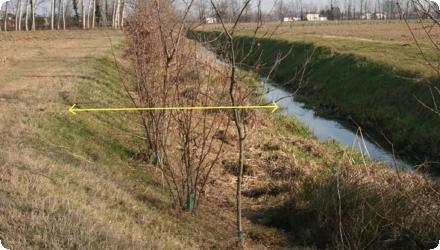
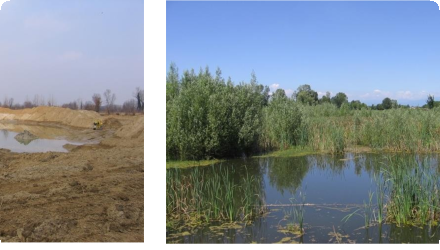
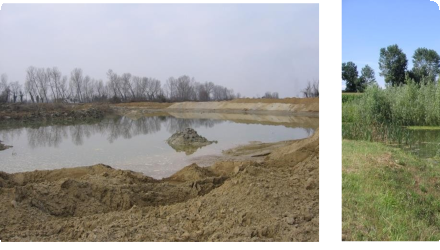
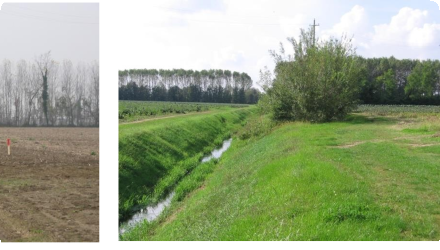
The project re-structured the mid-course effluents of the Dese - Rio San Martino, Rio Sant’Ambrogio and Scolo Desolino - whose primary function is to drain agricultural fields. Objectives were to retain nitrogen and phosphorus through phytodepuration and to mitigate frequent floods aggravated by urban sprawl, soil sealing and culverts (notably highlighted by the 2006–2007 Mestre events). Measures included riparian buffer strips, in- and out-of-channel wetlands, channel widening/meandering, and floodplain reconnection.
Subsequent technical documentation shows the programme extended beyond these three reaches to other local drains (e.g., Piovega di Scandolara, Piovega di Cappella, Piovega di Levada, Piovega dei Tre Comuni). Overall cost was about €4.13 million. Hydrological modelling and design analyses indicate peak flows delivered to the Dese fell from ~29 to ~25 m³/s (≈14% reduction), with tributary-scale decreases (e.g., Rio S. Martino 10.3→8.0 m³/s; Scolo Desolino 7.0→5.5 m³/s; Rio Sant’Ambrogio 11.5→10.5 m³/s).
Evidence from the implementer adds scale and design detail: about 14 km of channels were tackled in the Dese sub-basin; ~5.3 km of woody buffer strips were established across these reaches, and an out-of-channel wetland with a “double flow path” was created at Rio San Martino. On the Rio San Martino & Piovega di Scandolara sub-site specifically, ~1.6 km of new riparian woodland was planted.
Monitoring remains limited in the public domain: ARPAV was expected to monitor but little was published; the consortium ran some site-specific monitoring and used results from its NICOLAS experimental site for nutrient-removal parameters. Nonetheless, the combination of buffers, wetlands and planform restoration is credited by local sources with significant nutrient retention and visible flood-risk mitigation, supporting positive public perception.
Status on external registries is “complete”, and consortium material documents continued maintenance and allied works within the jurisdiction into the late 2010s. The case demonstrates multi-benefit restoration at drainage-network scale in a low-slope agricultural plain, aligning water-quality and flood-risk objectives under the Venice Lagoon Plan.
The project re-structured the mid-course effluents of the Dese - Rio San Martino, Rio Sant’Ambrogio and Scolo Desolino - whose primary function is to drain agricultural fields. Objectives were to retain nitrogen and phosphorus through phytodepuration and to mitigate frequent floods aggravated by urban sprawl, soil sealing and culverts (notably highlighted by the 2006–2007 Mestre events). Measures included riparian buffer strips, in- and out-of-channel wetlands, channel widening/meandering, and floodplain reconnection.
Subsequent technical documentation shows the programme extended beyond these three reaches to other local drains (e.g., Piovega di Scandolara, Piovega di Cappella, Piovega di Levada, Piovega dei Tre Comuni). Overall cost was about €4.13 million. Hydrological modelling and design analyses indicate peak flows delivered to the Dese fell from ~29 to ~25 m³/s (≈14% reduction), with tributary-scale decreases (e.g., Rio S. Martino 10.3→8.0 m³/s; Scolo Desolino 7.0→5.5 m³/s; Rio Sant’Ambrogio 11.5→10.5 m³/s).
Evidence from the implementer adds scale and design detail: about 14 km of channels were tackled in the Dese sub-basin; ~5.3 km of woody buffer strips were established across these reaches, and an out-of-channel wetland with a “double flow path” was created at Rio San Martino. On the Rio San Martino & Piovega di Scandolara sub-site specifically, ~1.6 km of new riparian woodland was planted.
Monitoring remains limited in the public domain: ARPAV was expected to monitor but little was published; the consortium ran some site-specific monitoring and used results from its NICOLAS experimental site for nutrient-removal parameters. Nonetheless, the combination of buffers, wetlands and planform restoration is credited by local sources with significant nutrient retention and visible flood-risk mitigation, supporting positive public perception.
Status on external registries is “complete”, and consortium material documents continued maintenance and allied works within the jurisdiction into the late 2010s. The case demonstrates multi-benefit restoration at drainage-network scale in a low-slope agricultural plain, aligning water-quality and flood-risk objectives under the Venice Lagoon Plan.
Position
Latitude
45.343
Longitude
12.0629
Project
NWRM
National Id
Italy_02
Installation date
2009-05
Implementation Status
Contact
Gloria De Paoli, ACTeon
RBD code
ITA
Transboundary
0
Photo gallery
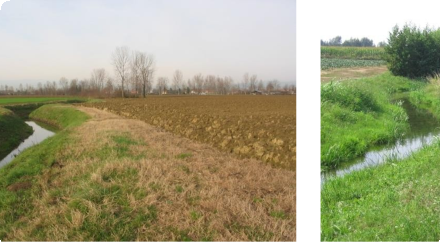
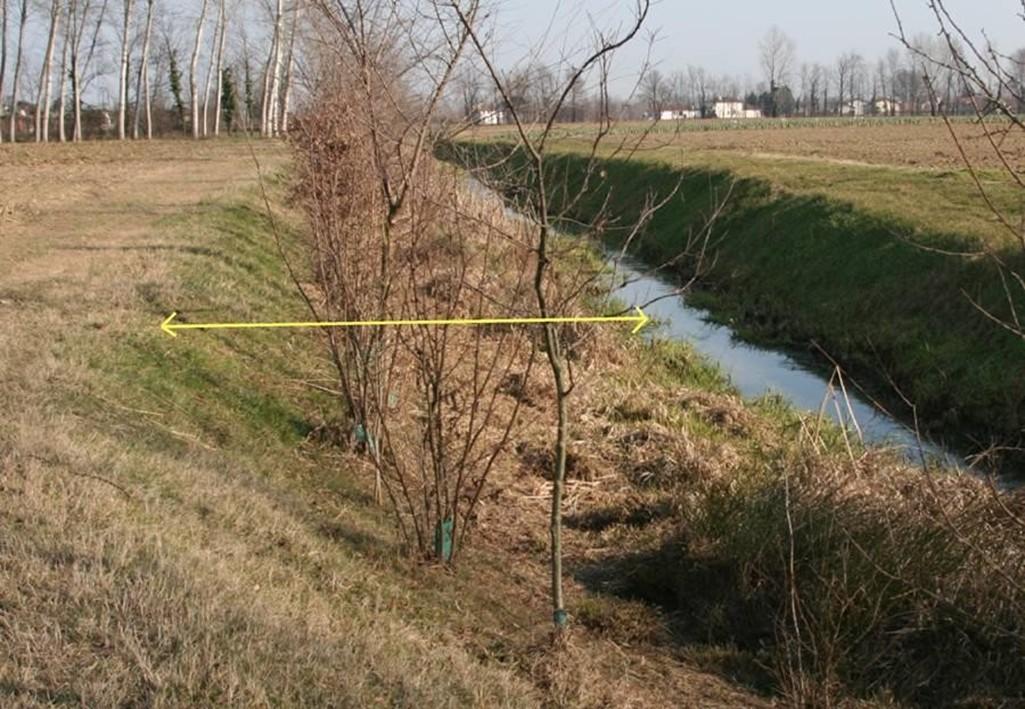
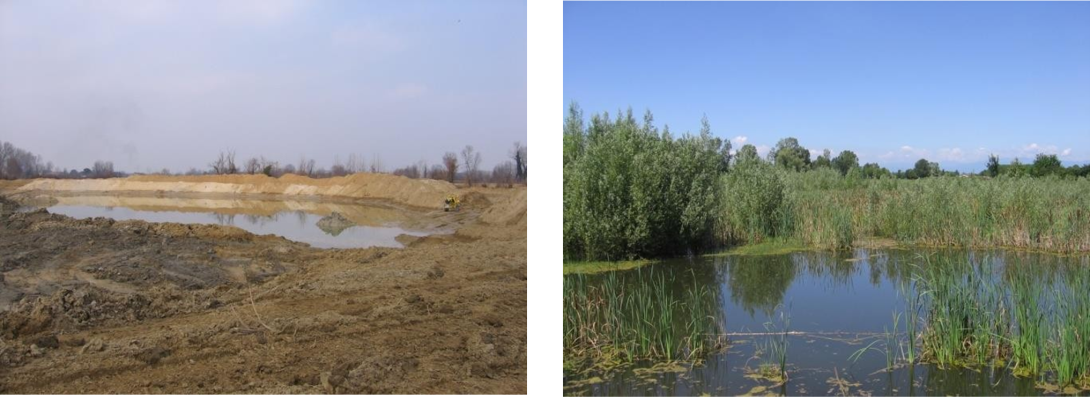
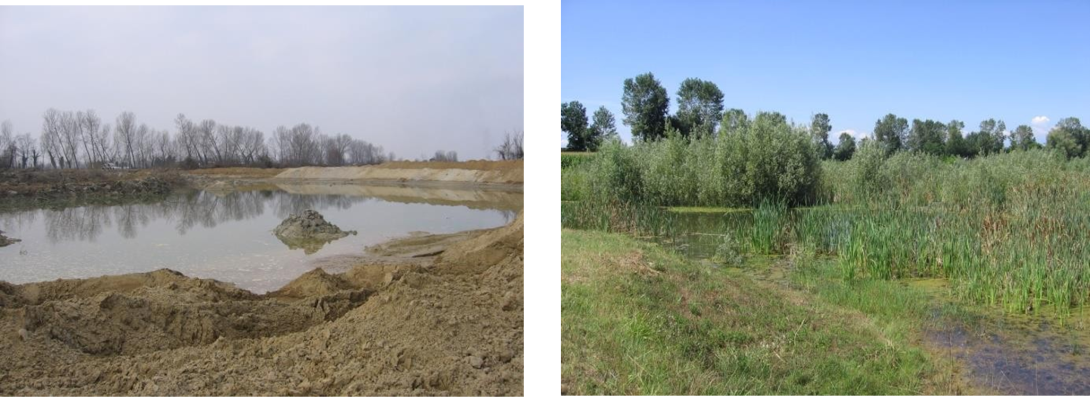
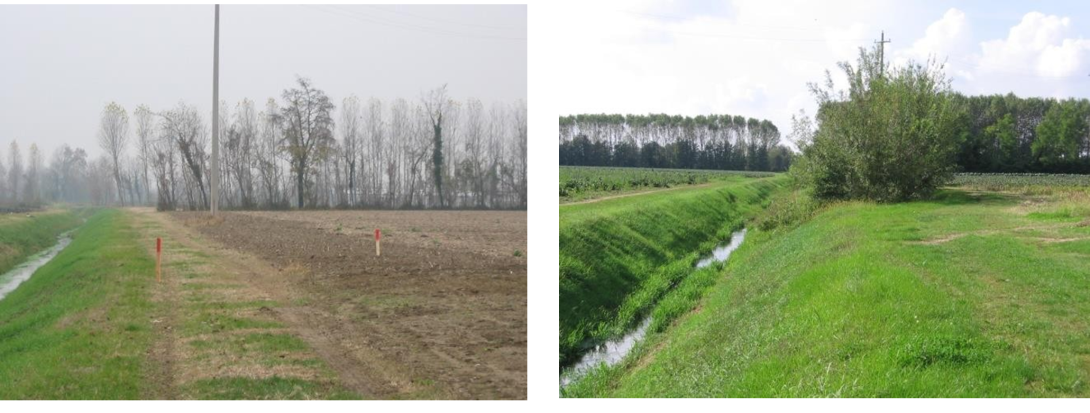
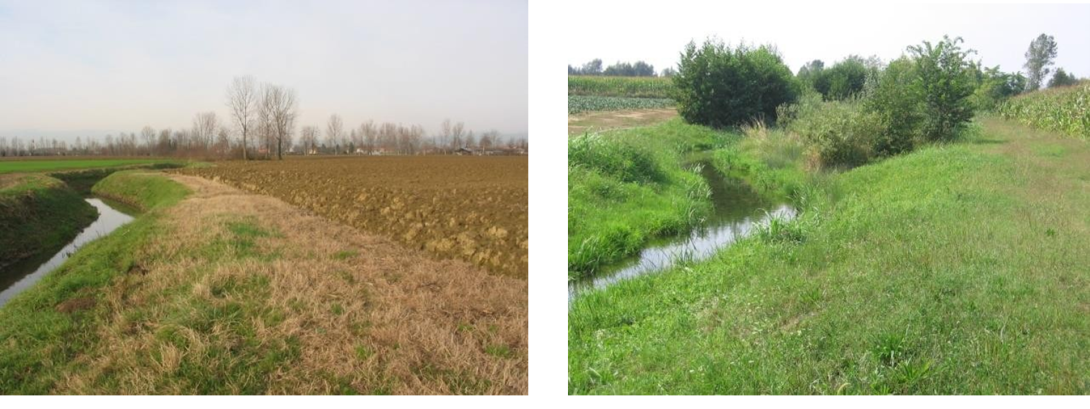
Location of the project
The case study is located in the draining basin of the Venice Lagoon. It is characterized by intensive agriculture and by a web of drainage channels discharging into the rivers. This case study, in particular, includes measures on the drainage channels discharging into the Dese river, one of the main water bodies of the Venice Lagoon basin.
NUTS Code
ITH3 - Veneto
Project's objectives
Expected impact on water quality (forecast based on experimental parameters from previous applied studies, caluclated in the design phase)
Total N reduction: 12.73 t/year
Total P reduction: 0.64 t/year
Mitigate flood risk by restoring the drainage channel web and reconnecting floodplain. Design target against ~30-year return period events; modelling indicated peak flows delivered to the Dese reduced from ~29 to ~25 m³/s (≈13.8% reduction).
Total N reduction: 12.73 t/year
Total P reduction: 0.64 t/year
Mitigate flood risk by restoring the drainage channel web and reconnecting floodplain. Design target against ~30-year return period events; modelling indicated peak flows delivered to the Dese reduced from ~29 to ~25 m³/s (≈13.8% reduction).
Involved Partners
| Authority type | Authority name | Role | Comments |
|---|---|---|---|
Climate zone
warm temperate moist
Temperature
13
Annual rainfall range
600 - 900 mm
Slope range
0-1%
Soil type
Calcisols
Vegetation class
The case study area is described as intensively farmed. Regional analysis of the Venice Lagoon draining basin shows agricultural areas exceed 77% of the territory. Together, these indicate the predominant cover is cultivated cropland (arable land) rather than natural grassland. In CORINE terminology this corresponds to class 2.1 “Arable land” (non-irrigated and irrigated fields).
Water bodies: Ecological Status
Bad
Water bodies: Chemical Status
Good
Project scale
Meso
Project scale specification
Creation of wetlands: 11,12 ha
Creation of buffer zones: 9,85 ha
Creation of buffer zones: 9,85 ha
Performance timescale
< 1 year
The measures were designed and modeled to protect from flood events generated by precipitations with a 30-years return time.
Over the years, the area has in fact been subject to massive urban development (new residential and industrial areas), with consequent soil sealing and culverted effluents: this had a devastating effect on the hydrological system. The strong floods of 2006 and 2007 on the city of Mestre, for example, were a consequence of this.
Over the years, the area has in fact been subject to massive urban development (new residential and industrial areas), with consequent soil sealing and culverted effluents: this had a devastating effect on the hydrological system. The strong floods of 2006 and 2007 on the city of Mestre, for example, were a consequence of this.
The measures were designed and modeled to protect from flood events generated by precipitations with a 30-years return time.
Design capacity description
The measures were designed and modeled to protect from flood events generated by precipitations with a 30-years return time.
Rio S. Martino
- Creation of a new diversion channel: reduction of discharge from 3.5 m3/s to 1.5 m3/s;
- Re-meandering of the first river section: the peak discharge at the entrance of Rio San Martino village was reduced from 5.1 m3/s to 2.9 m3/s
- Re-meandering downstream of the village reduced peak discharge from 10.3 m3/s to 8.0 m3/s, decreasing the discharge reaching the Dese river.
Scolo Desolino
Re-meandering reduced peak discharge from 7 m3/s to 5.5 m3/s, once again decreasing the peak discharge reaching the Dese river.
Rio S. Ambrogio
Thanks to the different measures, in case of peak discharge the river never overflows. Discharges decreased from 11.5 m3/s to 10.5 m3/s
Overall, the peak flows discharged by rivers and channels to the Dese river decreased from 29 m3/s to 25 m3/s.
Rio S. Martino
- Creation of a new diversion channel: reduction of discharge from 3.5 m3/s to 1.5 m3/s;
- Re-meandering of the first river section: the peak discharge at the entrance of Rio San Martino village was reduced from 5.1 m3/s to 2.9 m3/s
- Re-meandering downstream of the village reduced peak discharge from 10.3 m3/s to 8.0 m3/s, decreasing the discharge reaching the Dese river.
Scolo Desolino
Re-meandering reduced peak discharge from 7 m3/s to 5.5 m3/s, once again decreasing the peak discharge reaching the Dese river.
Rio S. Ambrogio
Thanks to the different measures, in case of peak discharge the river never overflows. Discharges decreased from 11.5 m3/s to 10.5 m3/s
Overall, the peak flows discharged by rivers and channels to the Dese river decreased from 29 m3/s to 25 m3/s.
Measures were implemented in a plain area, so geo- and hydro-morphology were not a constraining factor. The design of measures was based on hydrologic and hydraulic modeling.
Positive influence effectiveness
Measures were implemented in a plain area, so geo- and hydro-morphology were not a constraining factor.
Negative influence effectiveness
In some cases, negotiations for expropriations posed some challenges
Total cost
4,131,655 €
Costs total information
Scope extended beyond the 3 drains named on NWRM to include other local channels (e.g., Piovega di Scandolara, Piovega di Levada, Piovega dei Tre Comuni). Total treated length ≈ 14 km in the Dese sub-basin north of Scorzè. Project cost: €4,131,655.20.
Financing authorities
Type of funding
Sub-national funds
Comments
Through the "Plan for diffuse pollution prevention and restoration of water in the draining basins of the Venice Lagoon" financed measures of re-calibration of riverbeds aimed at the renaturation of the hydraulic web, to increase the time of permanence of water and phytodepuration processes in the draining basin.
Compensations
1
Compensations basis information
Measures were implemented on private land, which was thus expropriated – Expropriation involves compensation for landowners, although the price paid is lower as compared to a purchase of land on the market
Compensations scheme information
Measures were implemented on private land, which was thus expropriated. Expropriation involves compensation for landowners, although the price paid is lower as compared to a purchase of land on the market.
Policy context
The project tackles two problems at the same time:
- Retain part of the N and P loads from agricultural activities in the basin through phytodepuration ,thus reducing the amount of nutrients reaching the Venice Lagoon (the Lagoon is affected by serious eutrophication issues)
- Reduce the incidence and intensity of flood events in the area. Flooding issues had increased in the decades before the interventions mainly because the sections of the drainage channels were too narrow to contain water discharges in critical periods of the years. When the channels were built, their size was sufficient to contain high discharges, but then the landscape had changed: urban sprawling increased impermeable land, and also agricultural drainage practices (e.g. tubular drainage)had changed increasing discharge into channels.
According to the project's authors, in the framework of integrated landscape planning these two objectives proved to be totally synergic
- Retain part of the N and P loads from agricultural activities in the basin through phytodepuration ,thus reducing the amount of nutrients reaching the Venice Lagoon (the Lagoon is affected by serious eutrophication issues)
- Reduce the incidence and intensity of flood events in the area. Flooding issues had increased in the decades before the interventions mainly because the sections of the drainage channels were too narrow to contain water discharges in critical periods of the years. When the channels were built, their size was sufficient to contain high discharges, but then the landscape had changed: urban sprawling increased impermeable land, and also agricultural drainage practices (e.g. tubular drainage)had changed increasing discharge into channels.
According to the project's authors, in the framework of integrated landscape planning these two objectives proved to be totally synergic
Land ownership
The works were implemented on private land that was expropriated, with compensation to landowners (below market purchase price).
Community involvment
No
Policy target
| Target purpose |
|---|
|
Pollutants Removal
|
|
Peak-flow reduction
|
|
Improved Biodiversity
|
|
Oher Societal Benefits
|
Target Remarks
Natural assimilation (purification) of effluents through dilution, dispersion, and physic-chemical processes
Flood control and flood risk mitigation
Flood control and flood risk mitigation
Policy pressure
| Pressure directive | Relevant pressure |
|---|---|
|
WFD identified pressure
|
2.2 Diffuse – Agricultural
|
|
Floods Directive identified pressure
|
Natural exceedence
|
|
WFD identified pressure
|
4.1.2 Physical alteration of channel/bed/riparian area/shore of water body for agriculture
|
Pressures remarks
The interventions were not carried out as WFD or FD measures. The measures were rather made possible (and funded) by the “Plan for diffuse pollution prevention and restoration of water in the draining basins of the Venice Lagoon” (entered into force in 2000). It is also important to point out that interventions were mostly made on artificial drainage channels, which are not considered as “water bodies” according to the WFD (however, these channels do discharge into the Dese water body).
However, the objectives of the interventions, as well as the principles followed in their design and implementation, are in line with WFD and FD principles, so it has been possible to identify both WFD- and FD- related pressures.
However, the objectives of the interventions, as well as the principles followed in their design and implementation, are in line with WFD and FD principles, so it has been possible to identify both WFD- and FD- related pressures.
Policy impact
| Impact directive | Relevant impact |
|---|---|
|
WFD identified impact
|
Nutrient pollution
|
|
WFD identified impact
|
Altered habitats due to morphological changes
|
|
Floods Directive identified impact
|
Community
|
|
Floods Directive identified impact
|
Property
|
Policy challenges requirements
The “Plan for diffuse pollution prevention and restoration of water in the draining basins of the Venice Lagoon” (entered into force in 2000) is aimed at addressing the serious eutrophication issues affecting the Venice Lagoon. The draining basin of the Venice Lagoon is in fact characterized by intensive agriculture, responsible for the discharge of large amounts of nutrients (N and P) into the lagoon.
Contractual arrangements
0
Part of wider plan
1
Wider plan type
| Wider plan type | Wider plan focus | Name | Comments |
|---|---|---|---|
|
Plan for diffuse pollution prevention and restoration of water in the draining basins of the Venice Lagoon
|
The "Plan for diffuse pollution prevention and restoration of water in the draining basins of the Venice Lagoon" (entered into force in 2000) is aimed at addressing the serious eutrophication issues affecting the Venice Lagoon. The draining basin of the Venice Lagoon is in fact characterized by intensive agriculture, responsible for the discharge of large amounts of nutrients (N and P) into the lagoon. The Veneto Region, through the "Plan for diffuse pollution prevention and restoration of water in the draining basins of the Venice Lagoon" financed measures of re-calibration of riverbeds aimed at the renaturation of the hydraulic web, to increase the time of permanence of water and phytodepuration processes in the draining basin.
|
Monitoring is supposed to be carried out by the Regional Agency for Environmental Protection, but actually little has been done so far. The Consorzio carried out some monitoring in some sites, but these data were not shared.
Monitoring is supposed to be carried out by the Regional Agency for Environmental Protection, but actually little has been done so far. The Consorzio carried out some monitoring in some sites, but these data were not shared.
Specific monitoring of N retention was carried out in another site, where similar measures were also implemented by the Consorzio, in the experimental site NICOLAS.
Specific monitoring of N retention was carried out in another site, where similar measures were also implemented by the Consorzio, in the experimental site NICOLAS.
Maintenance
In practice, in some cases a more regular maintenance is needed (e.g. to avoid that buffer zones shed shadows on cultivated crops). In the case of intermediate meanders, no maintenance is needed –although this caused some resistance among farmers.
Catchment outlet
Unclear - In general, discharge measurements
Recreational benefits for local inhabitants and visitors (creation of recreational trails). The measures created pleasant natural environments and residents are now using the area for recreation (walking, biking). This has a great value in an area otherwise dominated by monoculture, with very little natural spaces.
Flood impact reduction: 13.8% overall reduction of peak flows into the Dese river as compared to the situation before implementation Water quality improvement and reduction of N and P reaching the
Venice lagoon indirect benefits: biodiversity, tourism potential
Flood impact reduction: 13.8% overall reduction of peak flows into the Dese river as compared to the situation before implementation Water quality improvement and reduction of N and P reaching the
Venice lagoon indirect benefits: biodiversity, tourism potential
Peak flow rate reduction
14
Peak flow rate reduction unit
%
Information on Peak flow rate reduction
Overall, the peak flows discharged by rivers and channels to the Dese river decreased from 29 m3/s to 25 m3/s (13.8% overall reduction of peak flows into the Dese river)
Information on Ecosystem flood control volume
Overall, the peak flows discharged by rivers and channels to the Dese river decreased from 29 m3/s to 25 m3/s (13.8% overall reduction of peak flows into the Dese river)
Water quality overall improvements
Positive impact-WQ improvement
Information on Water quality overall improvements
Water quality improvements: the simulation conducted in the design phase indicate that a significant amount of nutrients can be retained by the measures. In addition, this is just one intervention areas, as similar measures were implemented in several other sites by the Consortium, as part of the Plan for the Venice lagoon: and, overall, since these interventions started the N content in the lagoon has actually decreased.
Information on Water quality Improvements (P)
Expected impact (forecast based on experimental parameters from previous applied studies)
Total P reduction: 0.64 t/year
Total P reduction: 0.64 t/year
Information on Water quality Improvements (N)
Expected impact (forecast based on experimental parameters from previous applied studies)
Total N reduction: 12.73 t/year
Total N reduction: 12.73 t/year
1
Overall, the environmental quality has increased, and new habitats were created. However, data on biodiversity improvements are not available
Ecosystem impact climate regulation
Increased permanent biomas
Information on Ecosystem impact climate regulation
In buffer zones (but limited area)
Information on Ecosystem provisioning services
Although measures have had a positive impact on water quality, water from rivers and channels is not used for human consumption, so "provision of clean water" has not been included in the list of ecosystem services.
Key lessons
The visible positive impact and effectiveness of the measures was a key success factor, as well as a key element to increase environmental awareness in the area. In particular, the ability of the measures to address two pressing environmental issues in the area, while raising environmental quality at the same time, is a key success factor.
The evident effectiveness of the measures were key in positively influencing public perception over interventions, and in particular:
• During the implementation phase, some residents complained for the annoyance (e.g. the dust lifted by the machinery). However, during the first intense precipitation, the rivers/ channels didn’t overflow (they would have before implementation), so residents understood the key role of measures for flood mitigation.
• The overall decrease of N levels in the Venice lagoon, which followed the implementation of these and other similar measures in several sites of the draining basin, contributed to gain a positive public perception of these measures.
In addition, the measures created pleasant natural environments and residents are now using the area for recreation (walking, biking). This has a great value in an area otherwise dominated by monoculture, with very little natural spaces.
Network-scale design matters: treating multiple small drains yields a measurable catchment-level flood-peak reduction to the main stem.
Pairing buffers + wetlands is effective: woody buffers intercept sub-surface farm runoff while in-/off-channel wetlands provide residence time—together delivering quantified P (and reported N) reductions.
Adaptive maintenance is key: keep most vegetation, intervene selectively (e.g., one bank/upper slopes), and use simple control weirs to maintain wet habitats without sacrificing conveyance.
Long-term stewardship: documented post-project maintenance and extensions by the consortium sustain functionality and social acceptance.
The evident effectiveness of the measures were key in positively influencing public perception over interventions, and in particular:
• During the implementation phase, some residents complained for the annoyance (e.g. the dust lifted by the machinery). However, during the first intense precipitation, the rivers/ channels didn’t overflow (they would have before implementation), so residents understood the key role of measures for flood mitigation.
• The overall decrease of N levels in the Venice lagoon, which followed the implementation of these and other similar measures in several sites of the draining basin, contributed to gain a positive public perception of these measures.
In addition, the measures created pleasant natural environments and residents are now using the area for recreation (walking, biking). This has a great value in an area otherwise dominated by monoculture, with very little natural spaces.
Network-scale design matters: treating multiple small drains yields a measurable catchment-level flood-peak reduction to the main stem.
Pairing buffers + wetlands is effective: woody buffers intercept sub-surface farm runoff while in-/off-channel wetlands provide residence time—together delivering quantified P (and reported N) reductions.
Adaptive maintenance is key: keep most vegetation, intervene selectively (e.g., one bank/upper slopes), and use simple control weirs to maintain wet habitats without sacrificing conveyance.
Long-term stewardship: documented post-project maintenance and extensions by the consortium sustain functionality and social acceptance.
Success factor(s)
| Success factor type | Success factor role | Comments | Order |
|---|---|---|---|
|
Attitude of the public
|
secondary factor
|
<p>The measures created pleasant natural environments and residents are now using the area for recreation (walking, biking). This has a great value in an area otherwise dominated by monoculture, with very little natural spaces. Furthermore, the possibility of doing recreational activities has raised residents' awareness and interest towards the importance and role of measures, as well as on the importance and value of natural areas.</p>
|
3
|
|
Financing possibilities
|
main factor
|
<p>Availability of funds for this type of measures created by the Plan for the Venice Lagoon</p>
|
5
|
|
Other
|
main factor
|
The ability of the measures to address two pressing environmental issues in the area, while raising environmental quality at the same time, is a key success factor. |
|
|
Public participation
|
secondary factor
|
The measures created pleasant natural environments and residents are now using the area for recreation (walking, biking). This has a great value in an area otherwise dominated by monoculture, with very little natural spaces. Furthermore, the possibility of doing recreational activities has raised residents’ awareness and interest towards the importance and role of measures, as well as on the importance and value of natural areas. |
|
|
Attitude of the public
|
main factor
|
Driver
| Driver type | Driver role | Comments | Order |
|---|---|---|---|
|
Availability of subsidies
|
main driver
|
The Plan for the Venice Lagoon subsidized interventions to reduce eutrophication. The Consorzio chose NWRM because these measures also address flooding issues, quite common in the area
|
1
|
Flexibility adaptability
The measures reproduce or re-establish natural conditions and require little maintenance, so the sites should be able to adjust to changing baseline conditions.
Transferability
These type of measures can be seen as “standard” agricultural measures, and they can in principle be applied in all plain areas where intensive agriculture is practiced, with a dual objective (i) nutrient reduction and (ii) flood mitigation, while improving habitats and the environmental quality at the same time.
Cost effectiveness
Alternative measures for floods would include building weirs and protection barriers over large areas, and they would be more expensive than implemented NWRMs. Concerning N loads, mechanical/chemical treatment of effluents at scale is unfeasable.
Source(s)
English