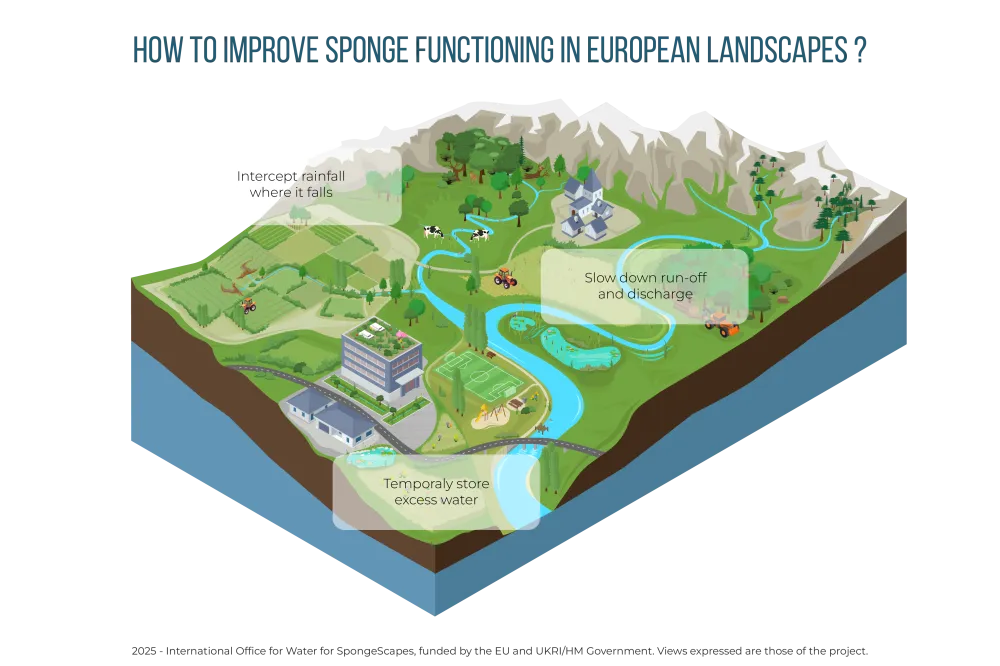
Sponge Measures cover a wide range of actions and land use types. Many different measures can act as sponge, by encouraging the retention of water within a catchment and, through that, enhancing the sponge functions of the catchment (for more details see the dedicated Spongescapes policy brief).
The catalogue of measures here under represents a comprehensive but non prescriptive wide range of measures, and you may have other measures, or similar measures that you call by a different name. Some identified alternative labels are included but there may be much more. When implementing one or more of these measures, it is always necessary to check they can qualify as Sponge Measures or NWRM. You can also access the illustrated catalogue in pdf, organised in 4 sectors and that provides in a printable format the definition and some illustrations for each Sponge measure. The current catalogue is an update of the NWRM catalogue and some changes in name and codes of the measures have been introduced. For those using the old NWRM classification, a correspondence table has been elaborated. If you are used to sector list, here are the specific entries: Urban, Agriculture, Forest, Hydromorphology.
The Sponge Measures Catalogue is a comprehensive list of distinct technical solutions that each are multifunctional and can provide a wide set of benefits and designed to improve water retention across various sectors and land use types. Created originally as part of the European NWRM project under the auspices of the European Commission and to support an enhanced implementation of the Water Framework Directive (WFD), it has been udpated in 2025 through the SpongeScapes Horizon project and aims to support sustainable water management by promoting natural practices that retain water within catchments.
The purpose of this catalogue is to provide you with a set of tested and validated measures, applicable in different contexts, whether in agriculture, forests, urban areas, or along rivers and lakes. These measures are designed to help you identify and implement solutions tailored to your needs, addressing water management challenges, reducing flood risks, preventing droughts, and improving soil and habitat quality.
As a user, this catalogue will not only allow you to discover and select the measures suited to your region, but also to better understand how these solutions can be effectively implemented and monitored. With the inclusion of technical information and practical recommendations, and with a link to the updated case studies catalogue, it is an essential tool for strengthening territorial resilience to climate change, through sustainable soil and water resources management and enhancement of biodiversity.
By using this catalogue, you are contributing to the achievement of European goals for water, soil and biodiversity, while improving the sustainability of practices in your field of activity.