Descriptive Fields
Water governance is a critical component of sustainable resource management, particularly in a context of increasing pressure on freshwater systems due to climate change, demographic growth, economic demands, and ecological degradation. While the concept of governance is now widely used in water-related policies, its meaning, scope and operational implications can differ significantly depending on institutional, territorial, and disciplinary contexts.
In its most basic terms, governance refers to the set of rules, processes, and institutions through which decisions are made and enforced. Applied to the water sector, governance determines how decisions about water allocation, protection, pricing, infrastructure and service provision are taken, by whom, and through which mechanisms. It encompasses not only formal institutions and legal frameworks, but also informal norms, stakeholder dynamics, and power relations.
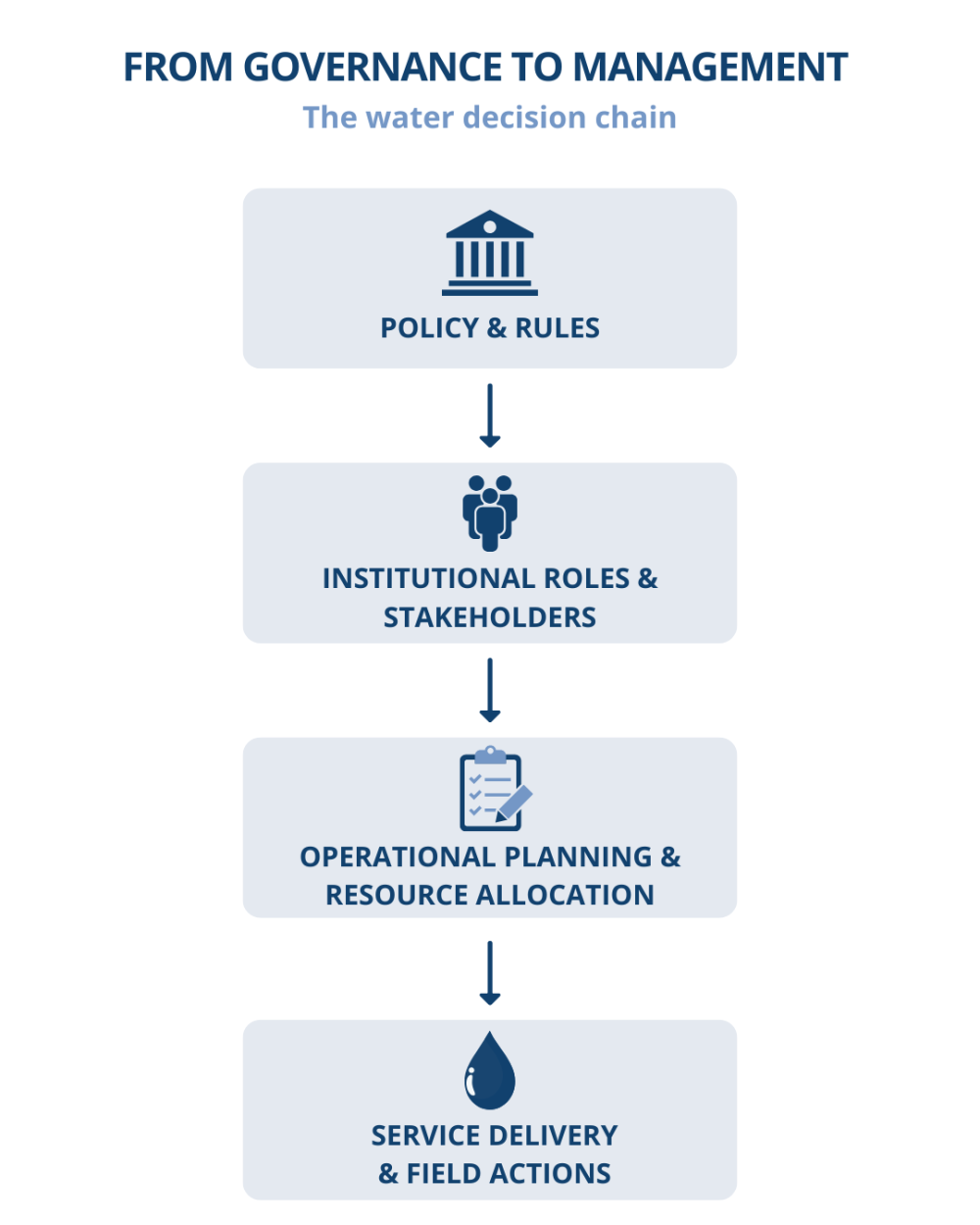
Water governance is often confused with water management, although the two concepts refer to different but complementary functions. Governance relates to decision-making, strategic planning, and institutional arrangements, while management focuses on the implementation of those decisions, including technical operations and service delivery.
This part lays the foundation for understanding what water governance entails and why it is increasingly recognised as a central lever for achieving social equity, environmental sustainability, and economic efficiency in water systems. It introduces the main governance functions, policy-making, regulation, service provision, enforcement, and situates them within the broader framework of multilevel and cross-sector governance.