
Descriptive Fields
Water Governance, Resilience and the Ecological Transition
Water governance plays a central role in enabling resilience and driving the ecological transition in Europe. Far from being a technical or administrative layer, governance is the framework through which complex, multi-scalar and interdependent environmental challenges are addressed in a coordinated and legitimate manner.
Governance determines how institutions respond to disruptions such as droughts, floods, water pollution, and ecological degradation. In the context of climate change, it provides the institutional capacity to absorb, anticipate, and adapt to environmental stress while maintaining equitable access and sustainability goals.
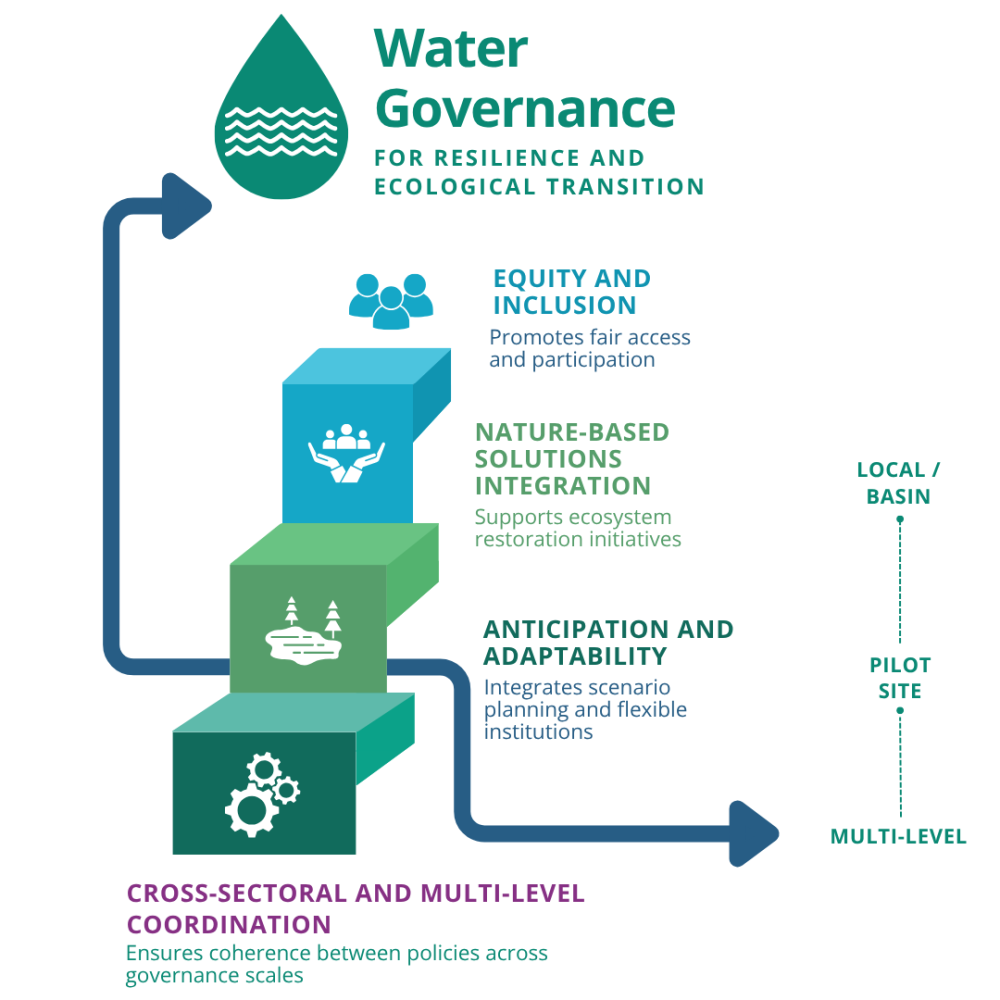
The InnWater project highlights four major governance levers for resilience and transition:
1. Coordination across sectors and scales
Climate, agriculture, biodiversity, energy, and urban planning are intrinsically linked through water. Effective governance ensures that policies across these domains are coherent and implemented collaboratively, avoiding fragmented responses to systemic risks.
2. Anticipatory and adaptive capacity
Governance must support real-time decision-making under uncertainty. This includes integrating early warning systems, scenario planning, and flexible institutional mechanisms that allow rule and role adjustments in response to extreme events.
3. Integration of nature-based solutions (NBS)
Ecological transition requires embedding ecosystem restoration and protection in governance processes. This involves creating legal and institutional spaces for NbS, incentivising investment, and aligning funding mechanisms such as green infrastructure plans with long-term ecological goals.
4. Inclusive and equitable access
Climate resilience cannot be achieved without social justice. Governance frameworks must ensure that vulnerable groups, including marginalised communities and future generations, are represented in decision-making and benefit equitably from adaptation strategies.
This holistic view is essential to operationalise the EU Green Deal and Biodiversity Strategy 2030, both of which position water as a vector for systemic transformation. According to InnWater, the governance of water is not simply a tool to implement these policies, it's the interface where ecological ambition, democratic legitimacy, and institutional capacity converge.