Content
Water governance refers to the political, institutional, administrative and social arrangements—formal and informal—that guide how water decisions are made, implemented and reviewed. It defines who does what, how rules are set and enforced, and how stakeholders and citizens can participate and hold institutions accountable.
Over the last decades, the focus has shifted: tackling water challenges through infrastructure and technical fixes alone has proved insufficient. Issues such as scarcity, pollution or unequal access are increasingly understood not only as “management problems”, but as symptoms of weak, fragmented or missing governance. As the OECD underlines, many water crises are, at their core, governance crises.
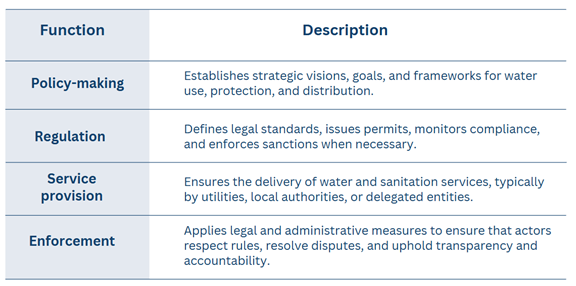
Water governance typically includes four core functions:
-
Policy-making: setting strategies, long-term goals, and rules for water use and protection
-
Regulation: creating and enforcing laws, standards and permits, and ensuring compliance
-
Service provision: delivering water and sanitation services (public, private, or hybrid)
-
Enforcement & accountability: monitoring, resolving disputes, applying sanctions, and ensuring responsibilities are met
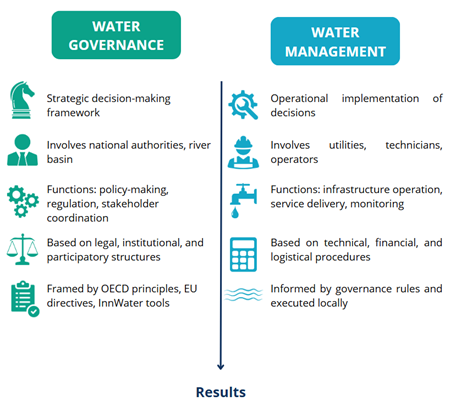
Governance ≠ management
-
Governance = who decides, under which rules, with what accountability and participation mechanisms
-
Management = day-to-day technical and operational delivery (running services, infrastructure, operations)
In short: governance comes first; it creates the conditions for management to work.
What “good governance” aims to secure
-
Transparency and clear information flows
-
Participation and meaningful stakeholder/citizen involvement
-
Accountability and traceable decisions
-
Integrity and fairness
-
Efficiency (resources, performance, coordination)
Finally, water governance is multi-level (local utilities, municipalities, basin organisations, national regulators, etc.) and dynamic: it must continuously adapt to climate change, evolving social values, demographic shifts, and technological change. Strong governance is therefore a cornerstone for water security, resilience, and sustainable use.