
Content
Water governance systems face combined pressures that are structural, social, economic and environmental. These challenges make trade-offs more visible, decisions more contested, and coordination more difficult—especially across territories and sectors.
Key challenges
1) Structural and institutional challenges
-
Fragmentation of responsibilities across institutions and governance levels
-
Overlapping mandates and unclear accountability
-
Coordination gaps between sectors (agriculture, energy, environment, urban planning, etc.)
-
Uneven capacities (technical, administrative, financial) across territories
-
Weak enforcement or inconsistent application of rules and standards
2) Social, economic and environmental pressures
-
Environmental stress: droughts, floods, degradation of ecosystems, water quality issues
-
Economic constraints: investment needs vs limited budgets; long-term asset maintenance
-
Social tensions: affordability, unequal impacts, low trust, limited participation
-
Conflict risks: allocation, pricing, restrictions, and environmental protection often become contentious when there are no trusted mechanisms for dialogue and arbitration
Response pathways (frameworks and practical guidance)
To design and assess what works, several international frameworks provide shared reference points. One of the most widely used is the OECD Principles on Water Governance (2015). The twelve principles help diagnose governance gaps and guide reforms that are:
-
Effective (clear roles, coherent policies, appropriate scale, capacity to implement)
-
Efficient (data, financing, regulatory quality, performance and innovation)
-
Trustworthy and inclusive (transparency, integrity, accountability, participation)
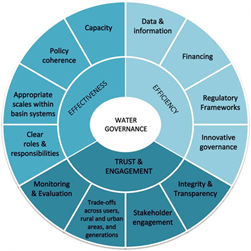
InnWater builds on these references with an operational framework adapted to the project’s realities (multi-level governance, cross-sector trade-offs, and the need for legitimacy and resilience). The InnWater governance framework is structured around four complementary dimensions:InnWater builds on these references with an operational framework adapted to the project’s realities (multi-level governance, cross-sector trade-offs, and the need for legitimacy and resilience). The InnWater governance framework is structured around four complementary dimensions:
Conceptual foundations commonly mobilised in InnWater
-
OECD governance approaches (diagnostic and reform guidance)
-
WEFE nexus (water–food–energy–ecosystems interdependencies)
-
Resilience thinking and adaptive governance (learning under uncertainty)
-
Social innovation (collaboration, experimentation, cross-sector solutions)
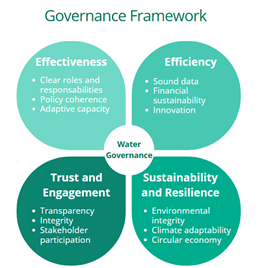
Overall, this framing treats governance as something alive and evolving: it must strengthen institutional performance, but also build trust, manage trade-offs fairly, and remain resilient under changing environmental and social conditions.