
Content
Integrated Water Resources Management (IWRM) is one of the core foundations of the InnWater approach. It provides a clear way to understand water issues as interconnected: water quantity and quality, land use, ecosystems, and human activities influence each other and need to be addressed together. In practice, IWRM is about coordinating how water and related resources are developed and managed so that social and economic wellbeing can be pursued while maintaining healthy ecosystems over the long term.
Why “integrated” matters
Across Europe, water governance is challenged by multiple, overlapping pressures: droughts and floods, pollution, competing uses (households, agriculture, industry, nature), and unequal access to services. When decisions are taken in isolation—by sector, by administrative boundary, or by institution—solutions may fix one issue while creating new problems elsewhere. IWRM helps keep the “big picture” in view and makes room for informed trade-offs, especially in contexts where water management is closely linked to land planning, agriculture, energy choices, and ecosystem protection.
Core principles of IWRM
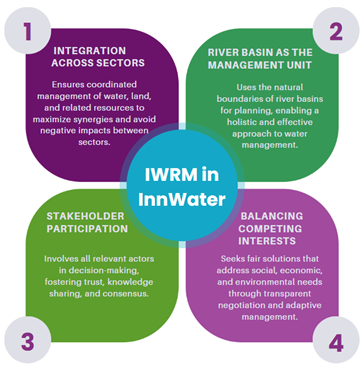
IWRM can be understood through a small set of practical principles that shape many of InnWater’s tools and pilot activities:
-
Integration across sectors: moving beyond “silos” so that policies in areas like agriculture, urban development, environment, or energy support each other rather than pulling in opposite directions.
-
The river basin as a meaningful scale: using the watershed (or river basin) to better capture upstream–downstream links, cumulative pressures, and shared solutions.
-
Stakeholder participation: involving public authorities, water utilities, economic actors, civil society and citizens so that decisions reflect local knowledge, needs, and constraints. In InnWater this is supported by mechanisms such as River Basin Water Forums and Citizen Engagement Roadmaps.
-
Managing trade-offs transparently: making competing objectives explicit (equity, affordability, economic activity, ecosystem needs) and creating conditions for dialogue and negotiation.
-
Adaptive management: recognising that water systems evolve (climate, demographics, infrastructure, expectations) and that governance needs monitoring, learning, and the ability to adjust over time.
Multi-level governance: the “who does what” of water decision-making
IWRM becomes effective only when responsibilities and resources can be aligned across levels. This is where multi-level governance matters: it describes how decision-making powers and duties are shared and coordinated between local actors (service delivery and proximity to users), basin or regional organisations (coordination at a functional scale), national authorities (regulation, funding frameworks), and EU/international levels (shared objectives, directives, cross-border cooperation). In Europe, this layered set-up is essential because many water challenges—and many solutions—do not stop at municipal or even national borders.
How these concepts connect to InnWater’s practical work
Within InnWater, IWRM and multi-level governance are not treated as abstract concepts. They are translated into concrete processes and support tools that help stakeholders clarify priorities, identify governance gaps, and structure cooperation. For example, diagnostic and digital tools (such as the Water Governance Diagnostic Tool and the InnWater Governance Platform) are designed to support evidence-based discussion, shared understanding, and learning across sites—while participatory methods help build legitimacy and trust around difficult choices.
Key takeaway
IWRM offers a way to manage water as a connected system, while multi-level governance provides the coordination backbone that makes integrated approaches workable. Together, they create a practical foundation for fairer, more resilient and more sustainable water governance—especially when combined with inclusive participation and tools that support learning and adaptation.