
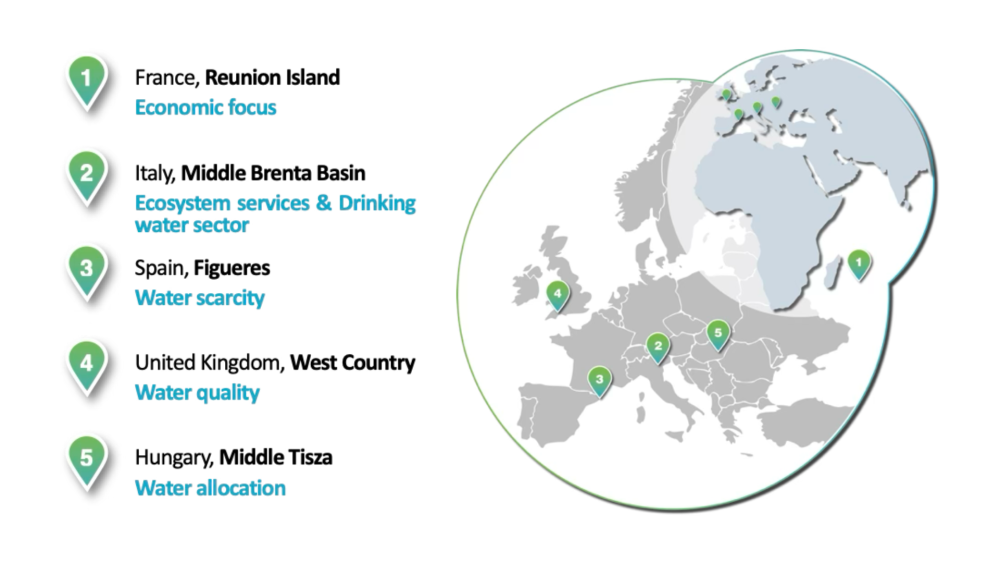
The InnWater pilot sites are the heart of the project. They are real-world laboratories where partners, authorities, users and citizens test new ways of governing water under climate and socio-economic pressures. Across five European river basins, InnWater explores how governance tools, economic instruments and social innovation can support fair, sustainable and transparent water management.
Each pilot site addresses a specific water challenge:
-
PS#1 – Réunion Island (FR): tariff design and investment planning in a context of strong inequalities and climate vulnerability.
-
PS#2 – Brenta (IT): implementation of Environmental and Resource Costs into the water tariff system as a key economic instrument.
-
PS#3 – Figueres (SP): severe supply problems and competing demands across the Muga fluvial system, in a territory strongly influenced by tourism.
-
PS#4 – West Country (UK): coordination of stakeholders to improve water quality at regional scale.
-
PS#5 – Middle Tisza (HU): allocation of water resources among competing uses in a heavily regulated river system.
Within InnWater, these sites form a governance community. Stakeholders co-develop and test tools such as the governance assessment framework, the quintuple-helix and citizen (trust) engagement approaches, and WEFE Nexus simulations linking water, energy, food, ecosystems and health. The insights generated in the pilot sites will feed into the InnWater governance platform, support policy and regulatory recommendations, and inspire replication in other European basins.
On this page, you can explore each pilot site in more detail: its local context, key water governance challenges, actors involved and the InnWater activities carried out there. The diagram below offers an at-a-glance view of how the five pilot sites fit into the overall InnWater approach and how they contribute to a shared community of practice on innovative water governance.