
Content
To ensure systematic documentation and comparability of measures, OPTAIN relied on the WOCAT (World Overview of Conservation Approaches and Technologies) questionnaire framework.
The WOCAT methodology provides a structured template to document land and water management technologies, including:
-
technical specifications of the measure,
-
required inputs and maintenance characteristics,
-
environmental conditions for applicability,
-
expected impacts on water, soil and nutrients,
-
socio-economic considerations.
Within OPTAIN, the WOCAT-based documentation served several purposes:
-
Standardisation – ensuring that NSWRM descriptions were harmonised across case studies.
-
Transparency – clearly defining assumptions used for modelling parameterisation.
-
Knowledge integration – capturing local expertise from stakeholders and Multi-Actor Reference Groups (MARGs).
-
Linkage to modelling – translating descriptive measure characteristics into model input parameters.
The WOCAT-based documentation therefore acted as an intermediate step between stakeholder knowledge and quantitative modelling. It supported the transition from conceptual measure identification to simulation-ready model representation.
By combining participatory identification with structured documentation, OPTAIN ensured that all modelled NSWRM portfolios were grounded in scientifically robust and context-specific information.
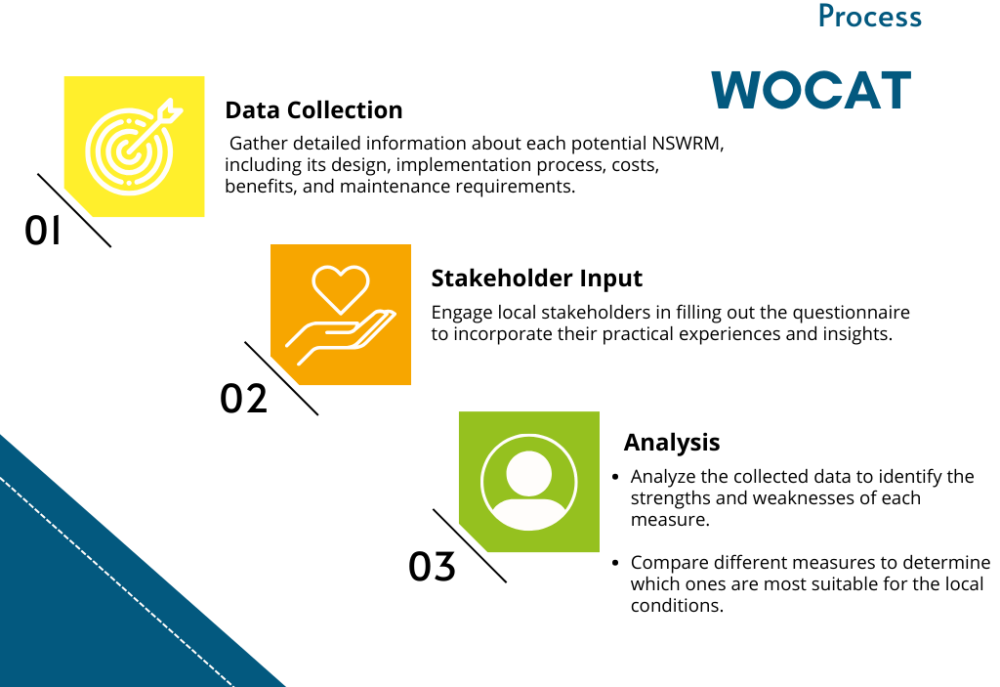
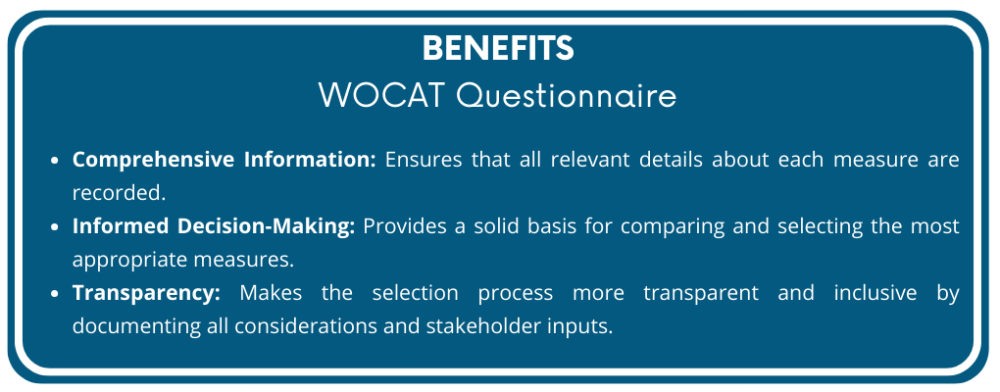
By using the WOCAT Questionnaire, NSWRM projects can systematically document and evaluate different measures, ensuring that the chosen solutions are well-informed and tailored to local conditions. This process not only enhances the effectiveness of the measures but also promotes knowledge sharing and collaboration among stakeholders.