
Content
Within OPTAIN, training sessions were organised to support local stakeholders in understanding the project’s model-based analytical framework and its application to Natural Small Water Retention Measures (NSWRM). These sessions did not focus on the physical implementation of measures in the field, but rather on strengthening participants’ capacity to engage with simulation results and optimisation outputs.
Training activities aimed to help participants:
-
Interpret hydrological and nutrient modelling results
-
Understand how NSWRM are represented within process-based models (e.g., SWAT+, SWAP)
-
Explore trade-offs identified through multi-objective optimisation
-
Discuss the implications of alternative NSWRM portfolios under current and future climate conditions
The sessions were adapted to the technical background of participants, ranging from farmers and advisors to researchers and public authorities. Visual tools, scenario comparisons and structured discussions were used to make complex analytical outputs accessible and meaningful.
By focusing on analytical understanding rather than field deployment, these training sessions strengthened stakeholders’ ability to participate in informed dialogue on water and nutrient management strategies, while preserving the scientific integrity of the modelling framework.
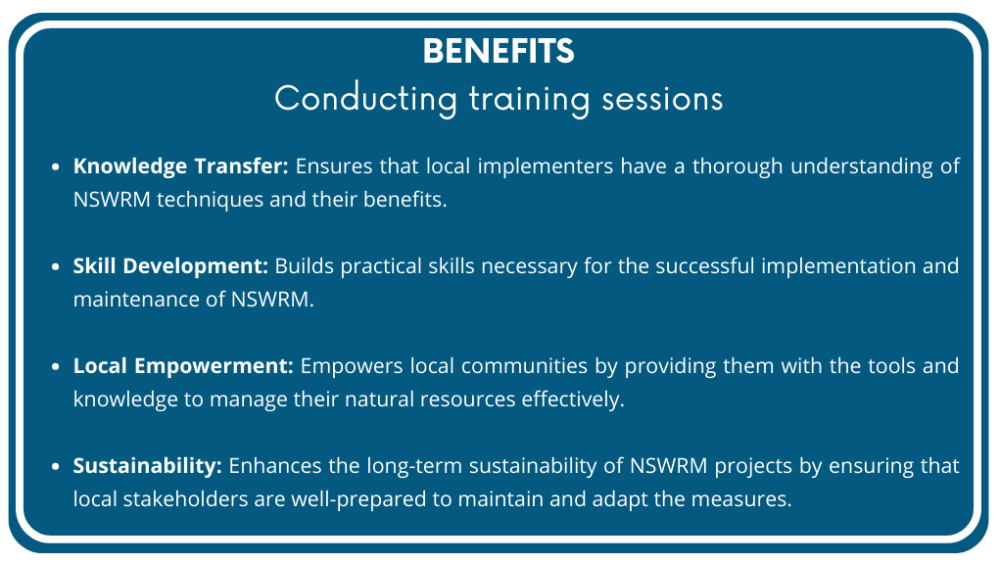
By focusing on comprehensive and context-specific training sessions, NSWRM projects can ensure that local implementers are well-equipped to carry out and sustain these measures, ultimately leading to more effective and enduring outcomes in water and nutrient management.