
Content
Data collection in OPTAIN was essential for building reliable modelling environments at field and catchment scale. Rather than collecting monitoring data from newly implemented measures, the project relied on existing environmental datasets, agricultural information, climate records, and hydrological observations to calibrate and validate process-based models.
The data collection phase focused on:
-
Soil characteristics and land-use information
-
Climate time series (precipitation, temperature, evapotranspiration)
-
Hydrological data (discharge records, flow dynamics)
-
Nutrient concentration data (nitrogen and phosphorus)
-
Agricultural management practices
These datasets were used to calibrate models such as SWAT+ and SWAP, ensuring that baseline simulations accurately represented catchment behaviour before introducing NSWRM scenarios.
As modelling progressed, methods were refined iteratively. This refinement did not involve adaptive field implementation but rather adjustments to model parameterisation, spatial allocation assumptions, and performance indicators. Stakeholder input helped ensure that modelling assumptions remained contextually realistic.
Through this process, OPTAIN strengthened the robustness and credibility of simulation outputs, allowing for consistent comparison across case studies.
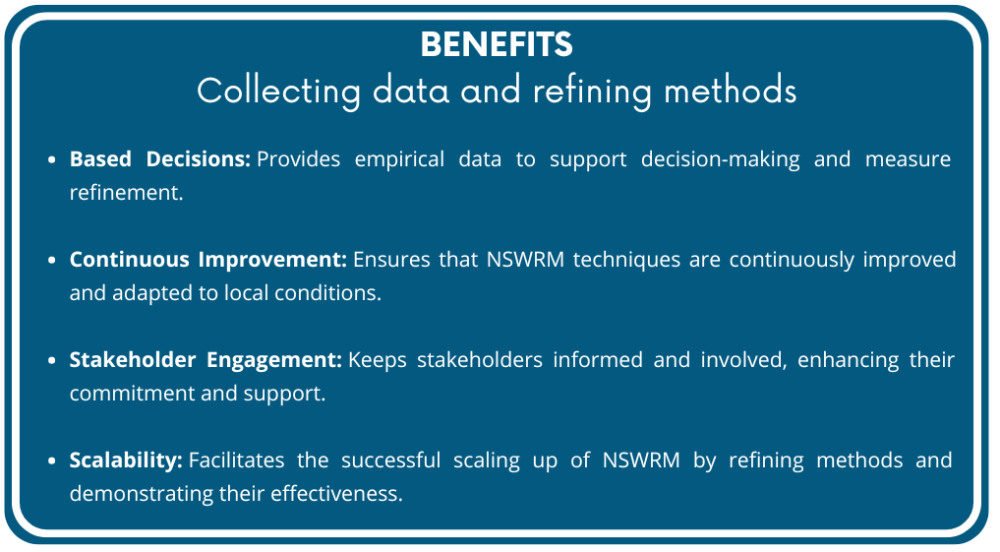
By systematically collecting data and refining methods during case studies, NSWRM initiatives can achieve greater effectiveness, sustainability, and stakeholder support. This approach ensures that the implemented measures are well-suited to local conditions and capable of delivering long-term benefits in water and nutrient management