
Content
Scenario analysis is a central element of the OPTAIN predictive modelling framework, enabling systematic exploration of alternative configurations of Natural Small Water Retention Measures (NSWRM). Rather than optimising real-world implementation, the modelling approach allows comparison of different spatial allocations and combinations of measures under varying environmental and climate conditions. Through these simulations, stakeholders gain insight into the model-based projections of how alternative NSWRM portfolios may influence hydrological and nutrient-related processes at catchment scale.
Each case study begins with the definition of a baseline scenario, representing current land-use patterns, soil characteristics, hydrological conditions and climate inputs. This reference configuration provides the foundation against which alternative scenarios are evaluated.
Building on this baseline, multiple NSWRM scenarios are constructed within the modelling environment. These scenarios reflect different spatial distributions and combinations of measures, and may also incorporate projected climate variations. Measures are parameterised within the model to simulate their potential influence on catchment processes.
Simulations are conducted using process-based models such as SWAT+ and complementary tools including SWAP, which represent water flow, sediment transport and nutrient dynamics over time. Model outputs typically include changes in water flow dynamics, nitrogen and phosphorus transport, sediment fluxes, and productivity-related indicators. It is important to emphasise that these outcomes represent simulation-based predictions, not empirical field observations.
The resulting outputs are then integrated into a multi-objective optimisation framework, where alternative NSWRM portfolios are compared. Instead of identifying a single optimal solution, the analysis produces Pareto-optimal configurations, highlighting trade-offs between objectives such as water retention efficiency, nutrient retention efficiency, agricultural productivity and cost-related metrics.
Stakeholders are involved throughout this process to discuss scenario assumptions, indicator selection and interpretation of optimisation results. Workshops and participatory modelling sessions facilitate dialogue on how different modelled portfolios align with regional planning priorities, ensuring that analytical results remain relevant and transparent.
Through this structured scenario analysis approach, OPTAIN provides a robust framework for evaluating alternative NSWRM planning strategies under current and projected climate conditions, grounded entirely in process-based simulation and optimisation analysis.
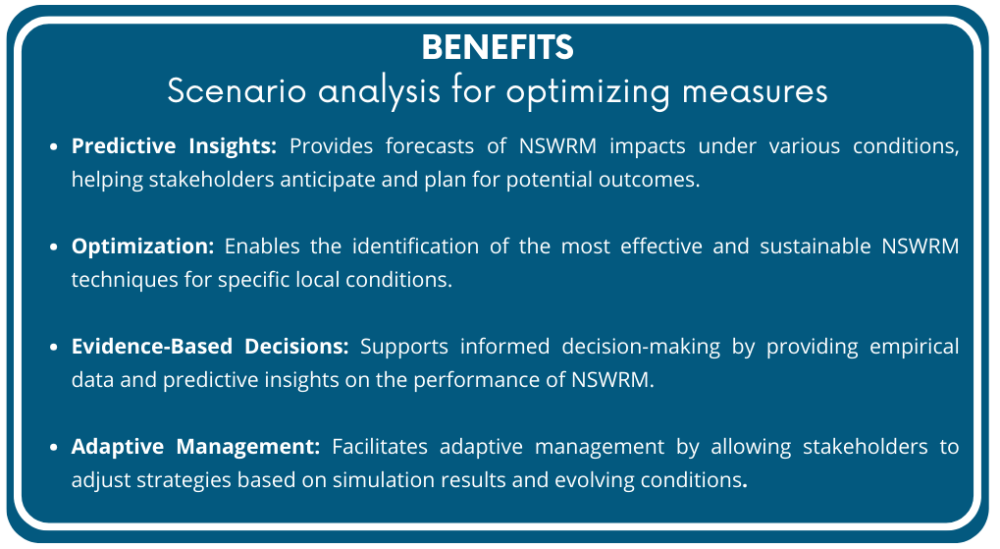
By using scenario analysis in model simulations, stakeholders can comprehensively assess the impacts of NSWRM, optimize their implementation, and enhance the overall effectiveness and sustainability of water and nutrient management practices. This approach ensures that the measures are well-suited to local conditions and capable of delivering long-term benefits.