Content
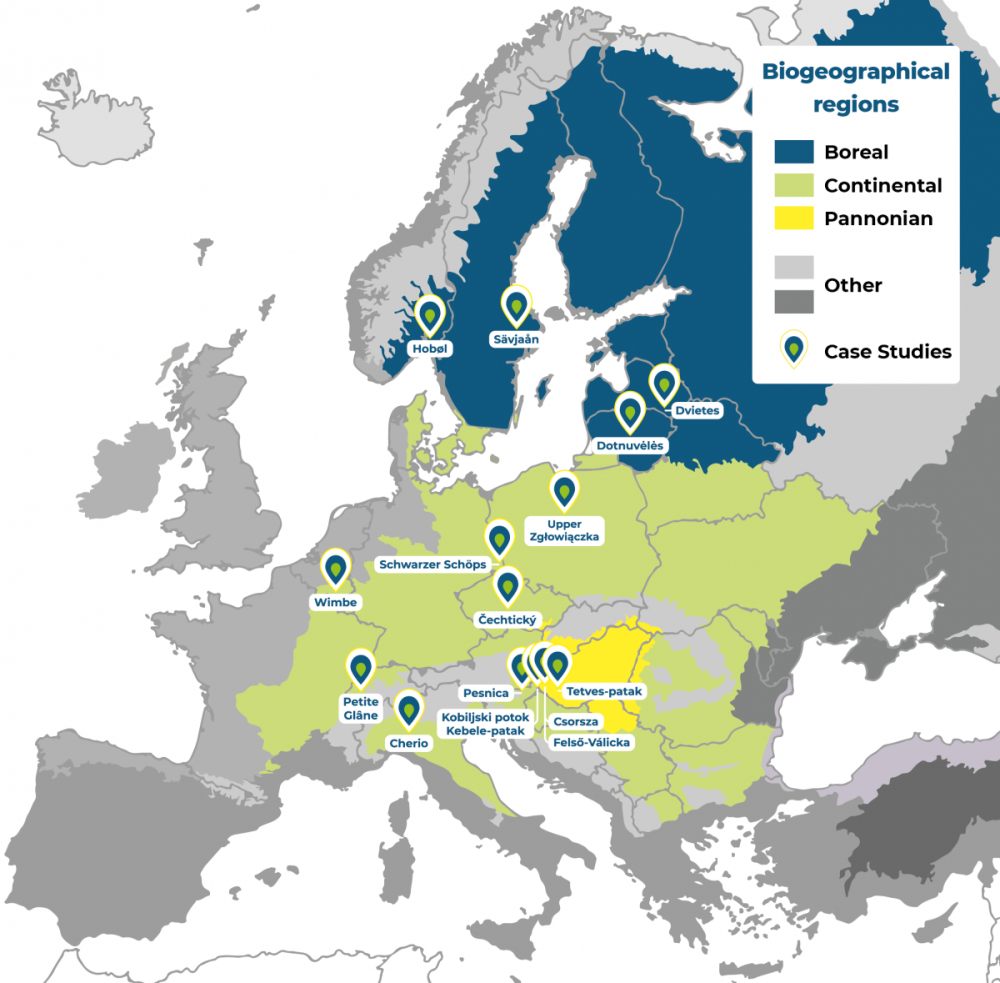
Simulation results across the OPTAIN case studies demonstrate that the performance of Natural Small Water Retention Measures (NSWRM) is strongly dependent on regional environmental conditions and spatial configuration. Using calibrated process-based models at field and catchment scale, the project assessed how different measures influence hydrological and nutrient dynamics under varying soil, climate and land-use settings.
Across regions, several consistent modelling patterns emerge:
-
Management measures, particularly reduced or no-tillage combined with cover crops, frequently show robust effects on soil moisture retention and reductions in phosphorus losses, especially under erosion-prone conditions.
-
Targeted vegetative structural measures, such as grassed waterways and riparian buffers, provide localised reductions in sediment and nutrient transport when strategically located in hydrologically connected areas.
-
Storage-related measures (e.g., retention basins or small reservoirs) exhibit variable performance, with outcomes highly sensitive to catchment topology and spatial allocation.
Field-scale simulations reveal that predicted impacts differ substantially between plots, depending on slope, soil texture and management intensity. When upscaled to catchment level, these effects interact through hydrological connectivity, leading to non-linear system responses.
Importantly, modelling results highlight that spatial targeting significantly enhances predicted effectiveness. Measures applied uniformly across a catchment generally perform less efficiently than strategically allocated portfolios.
These findings represent model-derived system responses within calibrated environments, providing analytical insight into context-specific performance patterns rather than empirical observations from implemented measures.