
Content
The Learning Environment provides structured access to detailed descriptions of documented NSWRM included in the OPTAIN catalogue.
Each measure entry contains harmonised information organised into clearly defined sections, typically including:
-
Measure description and technical characteristics
-
Intended hydrological function (e.g., runoff reduction, infiltration enhancement, nutrient retention pathways)
-
Spatial applicability conditions (soil type, slope, hydrological connectivity)
-
Potential interactions with agricultural management systems
-
Modelling-related parameterisation considerations
Where relevant, entries may also include:
-
Expected effects on water retention efficiency
-
Expected influence on nutrient retention efficiency
-
Interaction with crop productivity under simulated conditions
-
Indicative cost-related aspects used within optimisation analyses
The catalogue does not present empirical performance claims. Instead, it supports understanding of how measures are represented within predictive models and evaluated within optimisation frameworks.
Users can navigate the catalogue to:
-
Compare different measure types
-
Identify measures suitable for specific soil-climatic contexts
-
Understand how measures are combined into portfolios within optimisation scenarios
This structured documentation enhances transparency of modelling assumptions and facilitates reproducibility across case studies.
Lessons Learned
- User Familiarization: Spend time navigating and exploring the database to become familiar with its structure and features.
- Continuous Learning: Regularly visit the database to stay updated on new technologies and approaches.
- Community Contributions: Actively contribute to the database to enhance the collective knowledge and support global conservation efforts.
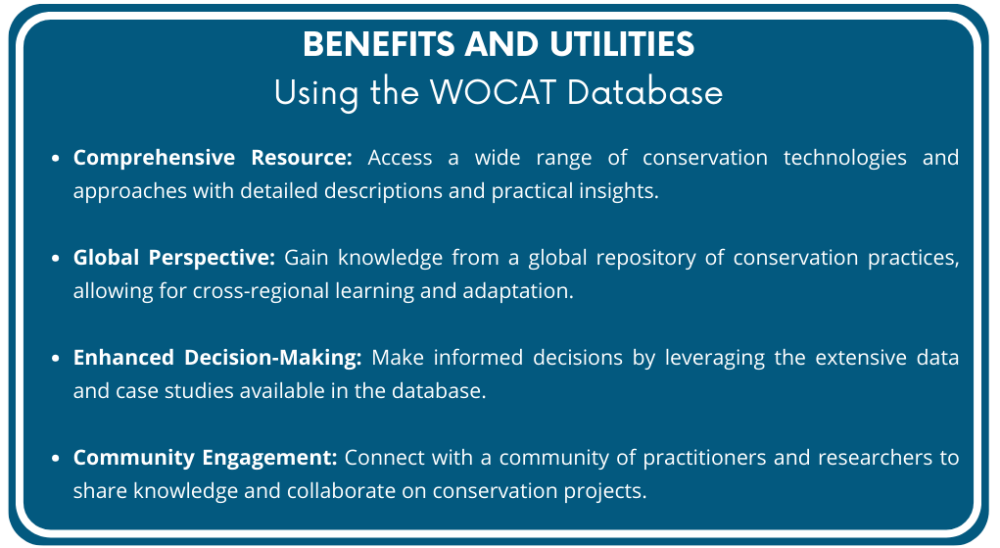
By following this methodology, stakeholders can effectively utilize the WOCAT database to enhance their research and implementation of NSWRM, leading to more sustainable and impactful water and nutrient management practices.