
Content
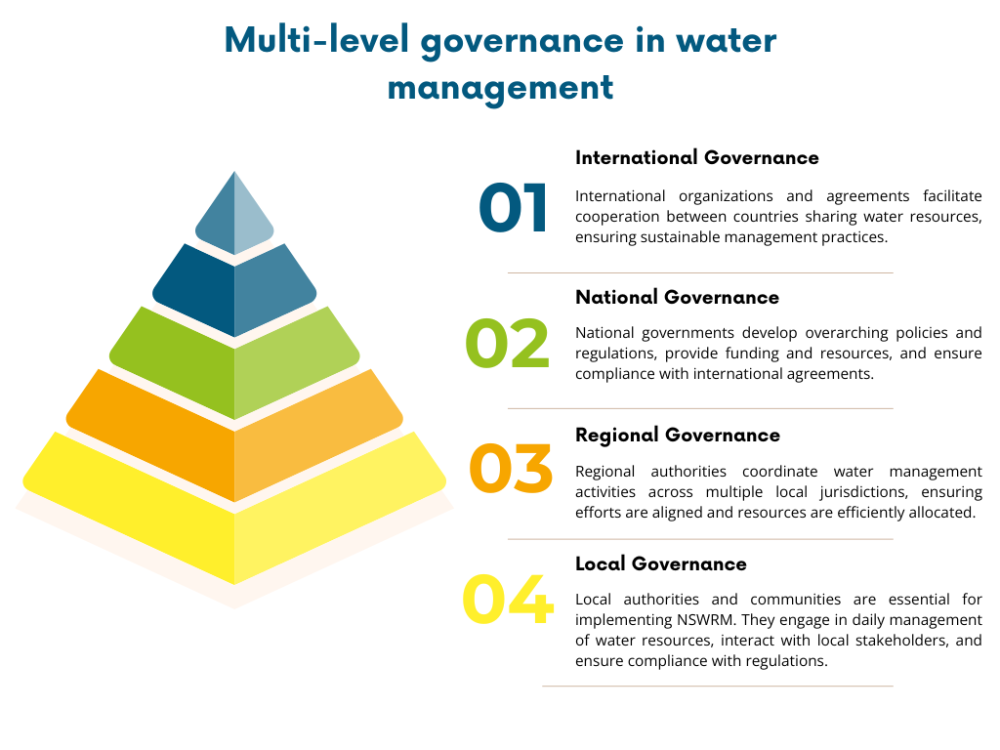
Effective water and nutrient management strategies are embedded within a structured multi-level governance system. Sections 4.1 and 4.2 of the OPTAIN Guidelines (D6.3) classify governance into distinct but interacting levels that influence the feasibility, coordination and incentive structures surrounding Natural Small Water Retention Measures (NSWRM).
Within the OPTAIN analytical context, governance levels are not evaluated in terms of measure deployment. Instead, they are examined as institutional environments that shape the attractiveness and policy alignment of model-identified NSWRM portfolios.
Governance Levels Relevant to NSWRM Strategies
D6.3 distinguishes governance across multiple hierarchical levels:
1. European (Supranational) Level
At the highest level, the European Union establishes overarching regulatory and strategic frameworks that influence water and agricultural management across Member States. Key instruments include:
- The Water Framework Directive (WFD)
- The Common Agricultural Policy (CAP)
- The Nitrates Directive
- Climate adaptation and environmental strategies
These instruments define:
- Environmental objectives (e.g., water quality targets)
- Funding structures (e.g., eco-schemes, rural development programs)
- Compliance requirements influencing agricultural management
For NSWRM portfolios identified through modelling and optimisation, EU-level frameworks provide the normative and financial architecture within which national measures operate.
2. National Level
National governments translate EU directives into domestic legislation and design country-specific implementation mechanisms. At this level:
- CAP strategic plans are operationalised
- National water management strategies are defined
- Financial incentives and subsidy schemes are structured
- Administrative procedures are established
The national level plays a critical role in determining whether analytically efficient NSWRM portfolios are economically attractive. Differences in subsidy design, eligibility criteria and cost-sharing mechanisms influence stakeholder preferences and perceived feasibility.
3. Regional and River Basin Level
Water governance is often organised at the river basin or regional level, where:
- River Basin Management Plans are developed
- Water authorities coordinate policy implementation
- Regional adaptation strategies are formulated
This level is particularly relevant for catchment-scale modelling results generated within OPTAIN. Since optimisation outputs are evaluated at catchment scale, alignment with river basin planning processes is essential for policy relevance.
Regional governance structures also facilitate coordination between agricultural and water authorities, helping to address cross-sectoral trade-offs revealed through optimisation.
4. Local Level
At the local scale, actors such as:
- Farmers and land managers
- Agricultural advisors
- Local water managers
- Municipal authorities
interact directly with regulatory and incentive systems.
Although OPTAIN did not organise real-world deployment of measures, stakeholder engagement activities demonstrated that local decision-making is strongly influenced by:
- Administrative complexity
- Financial risk perception
- Availability of advisory support
- Long-term policy stability
Local-level governance therefore determines the operational attractiveness of management and structural measures analysed in modelling exercises.
Interactions Between Governance Levels
The governance framework described in D6.3 emphasises that these levels are not isolated. Instead, they interact through vertical and horizontal coordination mechanisms.
Key interaction dynamics include:
- Vertical alignment between EU directives and national implementation mechanisms
- Horizontal coordination between water policy and agricultural policy
- Financial flows linking supranational funding with local actors
- Information exchange between modelling-based research and policy design
Optimisation results from OPTAIN highlight that efficient NSWRM portfolios often involve trade-offs between environmental objectives and economic considerations. The governance system determines how such trade-offs can be mitigated through:
- Targeted subsidies
- Regulatory adjustments
- Incentive alignment
- Advisory and capacity-building support
Relevance for Model-Based NSWRM Portfolios
The classification of governance levels clarifies that analytically efficient strategies identified through modelling are embedded within institutional realities.
In particular:
- Management measures may align more easily with existing CAP eco-schemes.
- Structural measures may require stronger financial instruments or coordination at basin level.
- Cost-related trade-offs identified in optimisation analyses can be moderated by appropriate incentive mechanisms.
Thus, the governance framework provides the institutional lens through which modelling and optimisation results must be interpreted.
Concluding Perspective
By structuring governance into European, national, regional and local levels, D6.3 provides a systematic understanding of the policy environment surrounding NSWRM. This multi-level classification supports:
- Contextual interpretation of optimisation outcomes
- Identification of enabling or constraining institutional factors
- Integration of analytical results into policy-relevant discussion
In the OPTAIN Learning Environment, the governance framework complements modelling and optimisation analyses by highlighting that institutional alignment and policy coherence are essential conditions for the practical relevance of scientifically efficient NSWRM portfolios.
Implementation Strategies
-
Coordination Mechanisms: Establish inter-agency committees, joint management boards, and stakeholder forums to facilitate collaboration.
-
Capacity Building: Invest in programs to enhance the skills and knowledge of stakeholders at all governance levels.
-
Data Sharing: Develop platforms for data sharing and communication to ensure access to accurate and up-to-date information.
-
Policy Harmonization: Work towards harmonizing policies and regulations across different governance levels to create a cohesive framework.
-
Monitoring and Evaluation: Implement robust systems to track the effectiveness of NSWRM and make necessary adjustments.
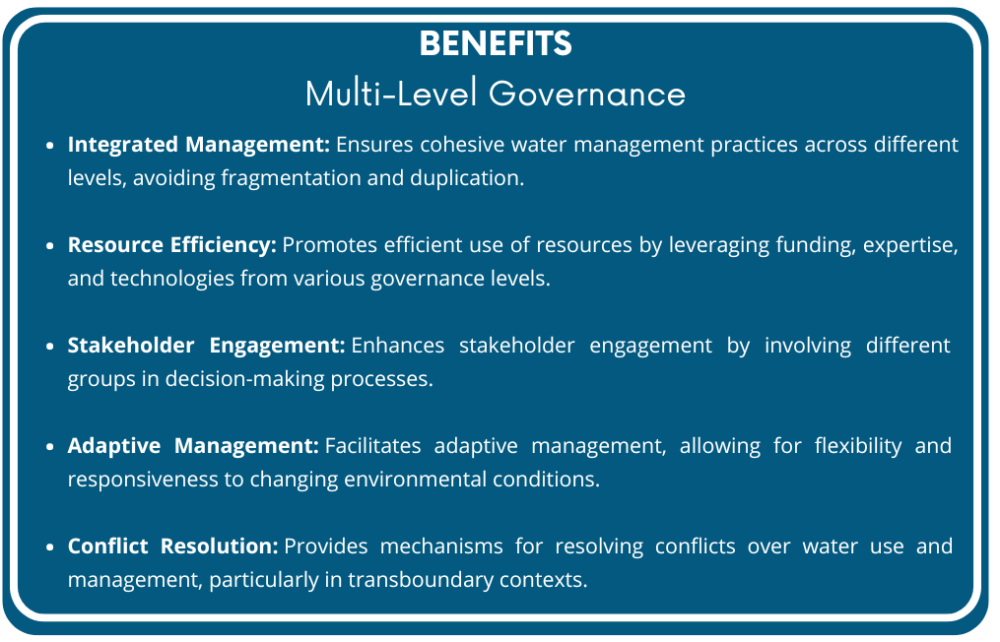
By adopting a multi-level governance approach, water management can be more effective, sustainable, and resilient, ensuring that NSWRM are implemented successfully and deliver long-term benefits for the environment and communities.