
Descriptive Fields
Introduction to stakeholder engagement
Engaging stakeholders is essential for achieving sustainable and widely accepted project outcomes. It can bring numerous benefits, such as:
Stakeholder engagement is a broad concept with diverse processes and various intentions. Often, the level of engagement is compared where each step represents higher ambition and impact on decision-making by stakeholders, where participation ranges from simply informing stakeholders to co-production and partnerships with co-decisions at the top.
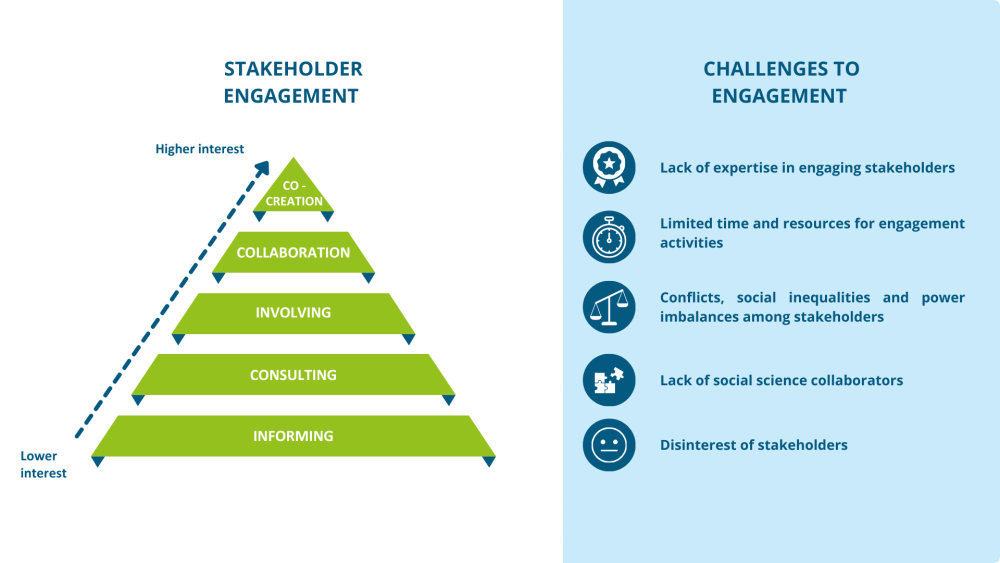
However, there can be challenges to stakeholder involvement, such as:
- lack of expertise in engaging stakeholders
- limited time and resources for engagement activities
- conflicts, social inequalities and power imbalances among stakeholders
- lack of social science collaborators
- disinterest of stakeholders
Even under good conditions, building trust and the perception of added value through project collaboration is a long-term process that requires sustained effort.
What is a stakeholder? |
A robust engagement process typically follows three phases:
- pre-engagement activities including planning the engagement process
- the actual engagement activities
- post-engagement evaluation of the process
Stakeholder engagement in the OPTAIN projectIn OPTAIN, multi-actor reference groups (MARGs) were created to achieve a harmonized engagement process across the 14 different case studies. It was the role of work package 1 (WP1) in OPTAIN to coordinate and harmonize the stakeholder activities, facilitate the establishment of MARGs and to ensure the link between the case studies, research and modelling work across all work packages.
The activities in the MARG were linked to every work package in the project. The goal was to bring together researchers and practitioners to ensure that research conducted in each case study addresses regional, local and small catchment scale problems and their unique characteristics, and that stakeholders establish a sense of co-ownership of the solutions developed and tested in the project.
The MARG platforms have been used to support co-production of knowledge and joint learning at the local level. They provide opportunities for all relevant stakeholders to be part of the modelling of various natural small water retention measures (NSWRMs). Stakeholders in OPTAIN typically include decision-makers, farmers, advisors, business actors, NGOs, and citizen groups.
The MARG platforms were consulted throughout the project on existing NSWRMs and the project’s modelling approach. They also provided inputs on local conditions and data, and suggested measures and techniques based on the local experience of scientific and non-scientific stakeholders. |
|
Arnstein, S. R. (1969). A Ladder Of Citizen Participation. Journal of the American Institute of Planners, 35(4), 216–224. https://doi.org/10.1080/01944366908977225 OECD (2015). Stakeholder Engagement for Inclusive Water Governance. https://read.oecd-ilibrary.org/governance/stakeholder-engagement-for-inclusive-water-governance_9789264231122-en#page1 |
Learn more about the different phases of stakeholder engagement: