
Content
There are many methods and strategies available for implementing stakeholder engagement. Choosing appropriate tools and methods depends on the type of the project and the level of participation the project is aiming to achieve.
In projects with many case studies, it is important to find a balance between a harmonized approach and specific case-study conditions and needs. Careful planning, relationship-building, and attention to equality can help prevent ‘stakeholder fatigue’ and lead to more successful participation.
Below are three main goals for this phase, including activities and outputs to achieve them.
|
Resources Bjørkan et al. (2023) Engaging Citizens with Mission Ocean and Waters: A toolbox of approaches. Milestone 6. Prep4Blue. https://prep4blue.eu/wp-content/uploads/2023/05/PREP4BLUE-Toolbox-for-Citizen-Engagement_V1.pdf Caspari, T. et al. (2014). RECARE WP4 / WP5 Project Guidelines Stakeholder Workshop 1: Participatory identification of measures to combat soil threats in Europe. https://www.isric.org/sites/default/files/Guideline_RECARE_SH_Workshop_2_final%20post.pdf Durham, E., Baker, H., Smith, M., Moore, E. & Morgan, V. (2014). The BiodivERsA Stakeholder Engagement Handbook. BiodivERsA, Paris. https://www.biodiversa.eu/wp-content/uploads/2022/12/stakeholder-engagement-handbook.pdf Gerlak, A. K., Guido, Z., Owen, G., McGoffin, M. S. R., Louder, E., Davies, J., Smith, K. J., Zimmer, A., Murveit, A. M., Meadow, A., Shrestha, P., & Joshi, N. (2023). Stakeholder engagement in the co-production of knowledge for environmental decision-making. World Development, 170, 106336. https://doi.org/10.1016/j.worlddev.2023.106336 OECD (2022), OECD Guidelines for Citizen Participation Processes, OECD Public Governance Reviews, OECD Publishing, Paris, https://doi.org/10.1787/f765caf6-en Reed, M. S. (2008). Stakeholder participation for environmental management: A literature review. Biological Conservation, 141(10), 2417–2431. https://doi.org/10.1016/j.biocon.2008.07.014 Reed, M. S., Vella, S., Challies, E., de Vente, J., Frewer, L., Hohenwallner-Ries, D., Huber, T., Neumann, R. K., Oughton, E. A., Sidoli del Ceno, J., & van Delden, H. (2018). A theory of participation: What makes stakeholder and public engagement in environmental management work? Restoration Ecology, 26(S1), S7–S17. https://doi.org/10.1111/rec.12541 Van den brink, C., De Vries, A., Nesheim, I. (2021). Workshop and workshop report on how to establish and nurture MARG for constructive engagement in water - agriculture – environmental conflict related issues. Deliverable D1.2 Horizon 2020 OPTAIN Project, Grant agreement No. 862756. https://www.optain.eu/sites/default/files/delivrables/OPTAIN%20D1.2%20-%20Workshop%20and%20workshop%20report.pdf |
🔹 Goal 2a: Establish stakeholder engagement platforms
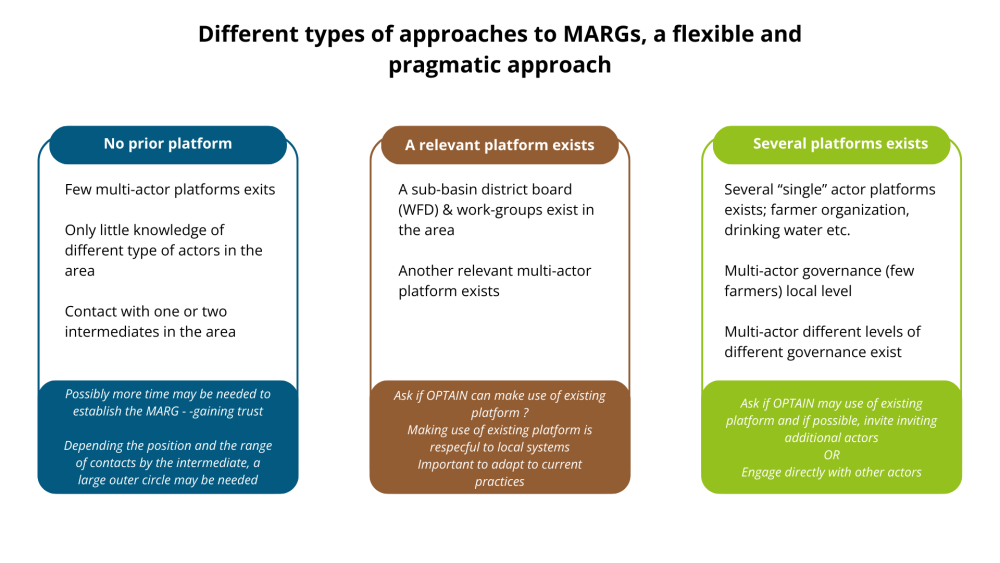
The platform for engaging stakeholders will depend on the project type and aims. It is important to carefully design and conduct the interactions to ensure effective and meaningful engagement. However, in most cases a flexible and pragmatic approach is needed, especially in projects with several platforms or case studies.
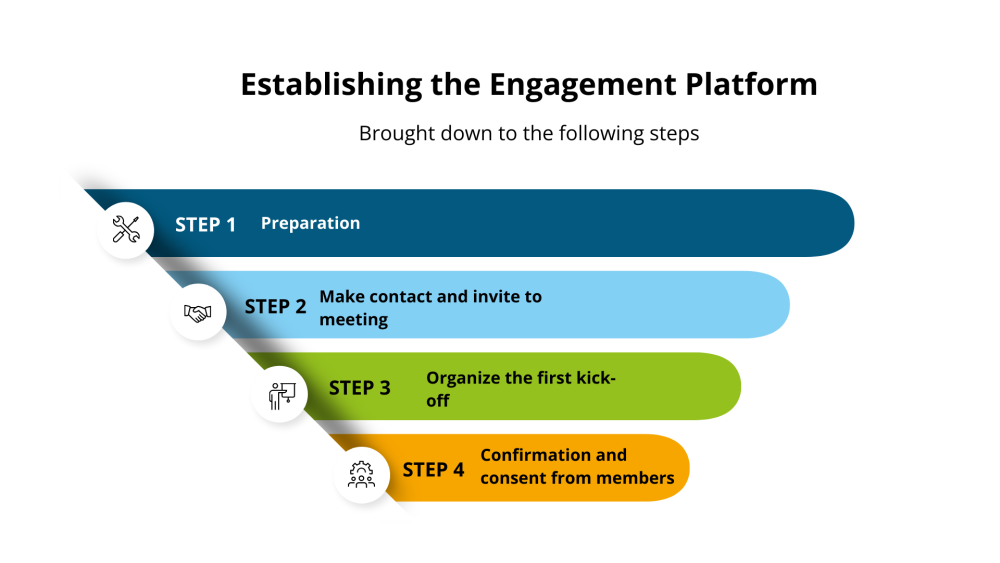
As the platform depends on the active participation of stakeholders, they should also be involved in decisions on how the interactions are facilitated and informing practical considerations. This may include choosing an appropriate venue, considering the timing of events, balancing physical and virtual interactions, providing information in local language, and so on.
Suggested activities and outputs:
-
Invitations for workshops. The format of invitations and initial contact with stakeholders should be tailored to different stakeholder groups, for example considering language and communication channels (email, phone, etc.). It is key to indicate how much time and effort is requested of the stakeholders and set realistic expectations.
-
Detailed workshop plan. Each workshop needs to be carefully planned and designed to ensure that the aims of the engagement are fulfilled. This includes both a plan for timing and the general content and format of the different workshops.
-
Overview of contacts who agreed to participate. As the project evolves, it is important to keep an overview of stakeholders and contacts that have agreed to participate. This should be continually updated in line with the data management plan and privacy protection guidelines, as roles and responsibilities may change or participants may choose to withdraw their consent.
Examples of guiding questions to establish the stakeholder engagement platforms:
-
When, where and how often is it useful to arrange stakeholder meetings during the project?
-
Are there any specific considerations that apply to certain stakeholder groups to ensure that they can participate (for example through bilateral or digital interactions)?
-
Is the workshop plan realistic, considering the time and resources available for both stakeholders and researchers?
How it was done in OPTAINThe OPTAIN approach to establishing MARGs : Multi-actor reference groups (MARG) were the primary engagement mechanism in the OPTAIN case studies. The MARGs included actors on local, regional and national levels representing decision-makers in both public and private sectors, as well as individual farmers and other actors. The local socio-economic context could also depend on other concerned stakeholder groups, such as local citizen groups, NGOs and farmer organizations. The MARGs were designed with an “inner circle” of actors directly targeted in most MARG activities, and an “outer circle” of actors to be involved in selected activities. As the case study context varied quite a lot across the different countries, the approach to setting up the MARGs was flexible and pragmatic rather than very strict. This also depended on the level of previous engagement and contact between researchers and stakeholders. In some case studies, engagement platforms already existed that could be used as a basis for OPTAIN activities rather than setting up a platform from the bottom involving the same stakeholders. Learn more about the approach establishing the MARGs in OPTAIN in the report: D1.2 Workshop and workshop report on how to establish and nurture MARG for constructive engagement in water - agriculture – environmental conflict related issues |
🔹 Goal 2b: Ensure harmonized, transparent and effective engagement activities
When conducting the stakeholder activities, careful planning is needed to ensure that each activity contributes to the goals of the project. In projects with several case studies or engagement platforms, guidelines and protocols with clear tasks for each workshop may help to achieve a harmonized methodology across cases. This can also increase the effectiveness of the engagement processes and ensure that all cases continue to progress.
However, some flexibility and adaptation are always helpful to ensure the stakeholders’ active participation and co-ownership. Openness around plans, agendas, potential changes and sharing information after and between activities contributes to transparency, which helps build trustful relationships.
Suggested activities and outputs:
-
Protocols and guidelines for tasks and activities. A protocol or guideline should include clear instructions for the tasks needed to fulfil the aims of the activity. It can for example include a suggested agenda, templates for presentations, group assignments and reporting results, as well as tips on practical matters such as timing, setup of the venue and suggested tools for engagement (apps, post-its, etc.).
-
Enabling interactions based on stakeholders’ needs. It may be necessary to adapt some activities according to different actors’ needs. For example, some may be prevented from participating during the daytime or in certain time periods, or they need to travel long distances. Strategies for including such stakeholders may be to arrange bilateral meetings, alter between daytime and evening events, and arrange digital or hybrid meetings.
-
Reporting and follow-up between interactions. After the activity, stakeholders should be reminded about the outcomes and what happened in the workshop, for example by sharing minutes and presentations. This also keeps those who were not able to attend updated. To keep stakeholders engaged, it is also useful to share other relevant updates between interactions - but not overdoing it to avoid stakeholder fatigue.
How it was done in OPTAINProtocols and guidelines for tasks and activities: During the project period, four main MARG workshops were conducted as well as several other activities such as interviews, surveys and other requests that were common to all case studies. As the activities were related to different work packages and tasks in the project, it was important to ensure a harmonized approach. Regular meetings for case study leaders (called ‘InterVision meetings’ in OPTAIN) were used to prepare and share the approaches and guidelines for different activities. For example, the guidelines for the third MARG workshop was developed as a collaborative effort by several work packages. The guideline included several components:
Specific principles and tools for MARG workshops were also provided. These are some examples:
In addition, a range of tips on practical considerations were provided, as well as a list of different resources and tools for engagement (e.g. Slido, Kahoot, Mentimeter). Serving lunch or coffee was also recommended, as this allows for more informal discussions among partners. Enabling interactions based on stakeholders’ needs: The case studies and MARGs in OPTAIN varied greatly, and different approaches were chosen here. In general, physical workshops were recommended, but virtual and hybrid meetings were also options, especially for activities including stakeholders such as national decision-makers. Bilateral meetings were also used as an option for actors that could not travel to the workshop. It was recommended to plan the duration of the workshops to accommodate the agenda, and this also varied between case study contexts.
Reporting and follow-up between interactions: Several recommendations on how to do this were provided to the case study leads, who chose different approaches. For example, it was recommended to attach a short summary of previous workshops when sending out invitations to a coming workshop. It was also recommended to send an email to the participants after the workshop, to thank for their attendance and contribution, including the slides presented (pdf). Another way of keeping the stakeholders updated, was an annual Christmas card prepared by the project. It was sent by email with a greeting that could be translated and tailored, for example by including a brief summary of specific results and activities in the case study throughout the year. |
🔹 Goal 2c: Continuous monitoring and follow-up
To ensure continued and relevant engagement, it is important to follow up any feedback or changes and continue to monitor the development of the engagement in the project. This enables a flexible and adaptive approach to facilitate stakeholders’ needs.
It is better to receive feedback and try to make improvements early, than to wait and risk not achieving results as stakeholders lose interest or are not able to keep engaging. Monitoring of engagement also creates a basis for evaluation and learning in the final phase of the project.
Suggested activities and outputs:
-
Logging and reporting of activities. Logs and reports help monitor activities and ensure that the engagement is going according to plan.
-
Surveys and interviews for feedback. Asking participants for feedback on project activities both directly and indirectly can ensure relevance and help detect any potential issues and adapt accordingly. Such methods can also be used to capture the researchers’ experience of the engagement process.
-
Follow-up and communication in the project team. Internal discussions along the way help the researchers reflect on the engagement situation and can contribute to finding good solutions to potential issues.
|
How it was done in OPTAIN Logging and reporting of activities. A template to report activities and results from MARG workshops across case studies was developed. It included:
A logging template for all stakeholder activities was also developed. Case study leads were encouraged to log each interaction with stakeholders (except emails and short phone calls) during the entire project period. This enabled work package 1 to monitor the development and level of activity in each case study.
The logs were compiled into annual milestone reports that presented general trends, as well as detailed overviews of activities and different stakeholder groups involved. The template included pre-defined categories to make it easier to fill in and to allow for comparison and simple statistics, as well as open categories for comments.
The logging template included information on:
Learn more about the approach to logging and reporting activities in OPTAIN in the report: Surveys and interviews for feedback. Work package 1 developed a short questionnaire for participants to be translated into local languages and distributed during the MARG workshops. The questionnaire was adapted to each workshop but also contained some of the same questions to detect any changes over time.
The questionnaire for participants included questions related to the following topics:
Work package 1 also conducted interviews with the case study leads / researcher teams in each case study to get their perspective on the relevance of engagement activities and situation of trust in the MARGs. The interviews followed a semi-structured format and were conducted two times for each case study – one interview after the first MARG workshop (2022) and a second after the third MARG workshop (2024/5). Learn more about the approach to surveys and interviews for feedback in OPTAIN (including the interview guides and questionnaires) Follow-up and communication in the project team. This was done both internally in the research team in each case study, as well as through the regular InterVision meetings across case studies in OPTAIN. In addition, the work package 1 team attended several workshops in different case studies to observe different approaches and encourage critical reflection on the engagement and co-creation process. Learn more about the approach to follow-up and reflection on engagement in the OPTAIN newsletter: Meaningful engagement is important for effective co-creation of knowledge |
