
Content
Evaluating stakeholder engagement is also a crucial part of the engagement process. Evaluation and summing up learning points may help with future planning, learning from experience, demonstrating to participants how their involvement matters, and providing evidence of the value of both the research process and its outcomes.
This phase includes evaluating the engagement phase as well as potential for consolidating and co-developing the engagement further.
Below are three main goals for this phase, including activities and outputs to achieve them.
|
Resources Blackstock, K. L., Kelly, G. J., & Horsey, B. L. (2007). Developing and applying a framework to evaluate participatory research for sustainability. Ecological Economics, 60(4), 726–742. https://doi.org/10.1016/j.ecolecon.2006.05.014 Nesheim, I. & Enge, C. (2022). Meaningful engagement is important for effective co-creation of knowledge. News update. OPTAIN. https://www.optain.eu/news/meaningful-engagement-important-effective-co-creation-knowledge Nesheim, I., Sundnes, F., Enge, C., Graversgaard, M., van den Brink, C., Farrow, L., Glavan, M., Hansen, B., Leitão, I. A., Rowbottom, J., & Tendler, L. (2021). Multi-Actor Platforms in the Water–Agriculture Nexus: Synergies and Long-Term Meaningful Engagement. Water, 13(22). https://doi.org/10.3390/w13223204 Ray, K. N. & Miller, E. (2017). Strengthening stakeholder-engaged research and research on stakeholder engagement. Journal of Comparative Effectiveness Research, 6(4), 375–389. https://doi.org/10.2217/cer-2016-0096 Rowe, G., & Frewer, L. (2013). Public Participation Methods: A Framework for Evaluation. Sci Technol & Hum Values, 25. https://doi.org/10.1177/016224390002500101 |
🔹 Goal 3a: Final evaluation and learning
Evaluation of the engagement process and results can be done by compiling the results of monitoring and reflection in phase 2. When the project is coming to an end it is useful to sum up, analyse and discuss these findings to allow for future learning.
Suggested activities and outputs:
-
Analysis of engagement logs, reports and surveys. The logs and reporting can be used for both qualitative and quantitative assessment, for example in a final evaluation report. If there are several engagement platforms or case studies, comparisons can be made, or it may be useful to compare results over time, such as difference between activities and participation in the early and late phases of the project.
-
Benchmark reporting. Using the benchmarks defined in phase 1 to evaluate results helps to make results more concrete and to evaluate whether the goals of the project were achieved. For learning, it is also important to reflect on why / why not this was the case.
Examples of guiding questions for final evaluation and learning:
-
What would have been done differently if you could re-do the process?
-
Were the main objectives and benchmarks achieved? Why/why not?
-
What were the main contributions / added value from stakeholder engagement in the project?
|
How it was done in OPTAIN Analysis of engagement logs, reports and surveys. The materials produced by case studies and work package 1 over the project period was summarized and analyzed in the final report Some results and general findings from the analysis: Example of figure: |
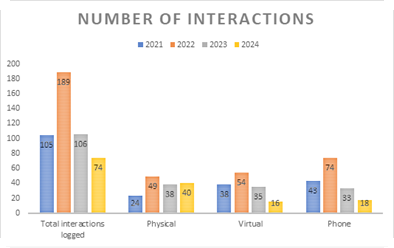
Benchmark reporting. The benchmarks in OPTAIN were evaluated during the final months of the project and presented in the report
🔹 Goal 3b: Consolidate engagement
The evaluation and learning achieved in the project should not just be kept internally in the project team. Both the stakeholders and other researchers may find the lessons learned valuable and of use in future activities. Ideally, the results of the project are also useful for stakeholders in their work, for example results on environmental measures and new techniques or informing policy. Sharing and making results available is therefore key to ensure that stakeholders get value back for their time and efforts given to the project.
The end of a project or stakeholder engagement process is not necessarily the end of engagement with relevant actors or in a specific area. For the researcher team it may have resulted in valuable contacts and data that can be the basis for future collaborations and projects. The platform may also have contributed to new networks and contacts between stakeholders with common interests, that they can continue to use or develop themselves.
Suggested activities and outputs:
-
Sharing of results and publications. It is essential to share results and lessons learned from the project so that others may utilize the knowledge developed and for potential replication. Publish in different formats tailored to reach different target groups, such as popular science publications, news articles, social media, websites, scientific publications, policy briefs, guides or handbooks.
-
Assess opportunities for future collaborations or engagement activities. The resources invested into building relationships and an engagement platform can be exploited in many ways. Make sure to keep in touch with important contacts and look for opportunities for future collaborations.
Examples of guiding questions to consolidate engagement:
-
What can others learn from the project and experiences on stakeholder engagement?
-
How can the new knowledge and networks resulting from the project be further exploited beyond the project?
-
Is there potential and reasons for continuing contact with the stakeholders?
|
How it was done in OPTAIN Sharing of results and publications. The OPTAIN project included a range of different types of outreach and publications for sharing results, both with stakeholders directly and to the general public. A key component of this is the online learning environment. |