
Content
Citizen engagement in InnWater is anchored in Directive 2000/60/EC and open government principles, empowering civil society across the full policy cycle and in service design and delivery, moving beyond one‑way information and non‑binding consultation toward meaningful influence and collaboration. Engagement is treated as a continuous, trust‑building process that must be tailored to socio‑political, economic, environmental, cultural, and gender dynamics, with clear links to decision‑making and sufficient time, information, and resources for citizens to generate high‑quality, collectively legitimate inputs.
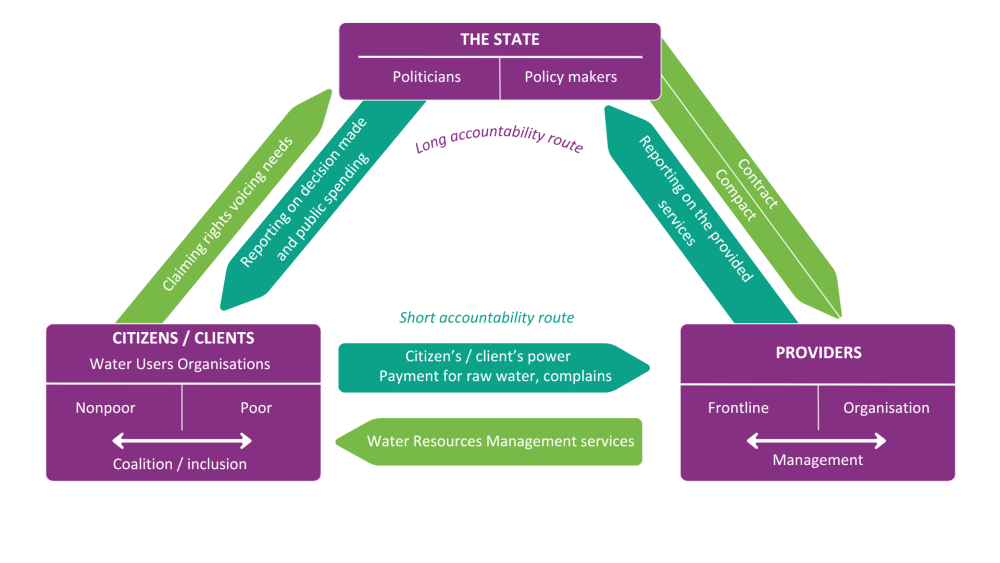
Citizen engagement initiatives typically involve three groups of stakeholders: citizen groups, policymakers, and service providers. Translated to the accountability framework the citizens are the users, while the politicians are the policy makers, and the public officials are the service providers. This is important to consider as accountability is viewed as the democratic principle whereby elected officials and those in charge of providing access to water supply and sanitation services account for their actions and answer to those, they serve. Public officials implement the strategic direction provided by the political leadership and deliver public services to citizens. They are accountable directly to politicians and only indirectly to the citizens. However, citizens may engage with public officials, and exact accountability directly from them. This is called “social accountability”. The figure below shows the relationship between the state, the service providers, and the citizens explained within the accountability triangle. It demonstrates that citizen engagement and social accountability at the local level can result in inclusion of vulnerable groups, as well as support building coalitions among the different citizen groups, and thereby support community building.
Objectives of Citizen Engagement
-
Strengthen governance quality by grounding decisions in shared knowledge and by clearly linking participation to decision‑making to improve public service design and delivery through workable, acceptable arrangements.
-
Enhance democratic legitimacy by aggregating citizen preferences, promoting transparency, and clarifying social and political accountability relations among users, policymakers, and service providers.
-
Broaden inclusion and representation by bringing diverse perspectives, including rarely heard voices, minorities, vulnerable groups, and women, into agenda‑setting, policy formulation, and implementation.
-
Build trust and constructive relations through ongoing communication, cooperation, and collaboration, supported by clear feedback on how inputs shape outcomes and by integrity safeguards.
-
Foster public learning, social cohesion, and community‑building by creating spaces for informed, collective judgements and coalition‑building among different citizen groups.
-
Improve policy results via early identification of impacts, co‑creation of tailored solutions, reduction of conflicts and long‑term management costs, and better alignment with citizens’ needs.
-
Support long‑horizon, value‑laden decisions that require trade‑offs and behavior change beyond electoral cycles by enabling meaningful citizen influence over time.
-
Spur public sector innovation and defend the public interest against clientelism, while bolstering public sector accountability and overall governance quality in context‑sensitive ways.