Content
This section distinguishes citizen engagement from broader stakeholder engagement so that participation is not confined to institutionalised actors but reflects wider civil‑society dynamics and community contexts, with the River Basin Water Forum (RBWF) acting as a guiding vision rather than a prescriptive structure.
Design should start from problem characterisation and an explicit articulation of the potential local role of a RBWF, then proceed to select feasible engagement approaches, plan timelines, specify feedback mechanisms, and define indicators to keep participation clearly linked to decision‑making over time.
A context‑specific analysis is required to determine who is involved and how, considering actors’ relation to the water issues, scales and timelines of action, representativeness, capacity for engagement, and the political, social, and environmental conditions, with explicit attention to inclusiveness by age, gender, minorities, and vulnerable groups in line with the Dublin Principles. Mapping should cover local demographics, community connectedness, existing decision‑making bodies and networks, communication channels, and local spokespeople or opinion leaders, aligning engagement with ongoing activities and resources and engaging diverse civil‑society actors (including potential “spoilers”) early to build trust and collective action.
Civil‑society examples to consider include water users and associations across sectors, local/regional/social media, NGOs and advocacy groups, landowners and unions, community‑based and neighbourhood organisations, and educational associations.
Quality principles underpin procedures so that processes remain transparent, accountable, inclusive, and adaptive: clarity and impact in problem framing; commitment and accountability by authorities; transparency and information sharing; inclusiveness and accessibility; integrity and privacy; and adequate resources for implementation, evaluation, and feedback with explicit communication of how inputs are used.
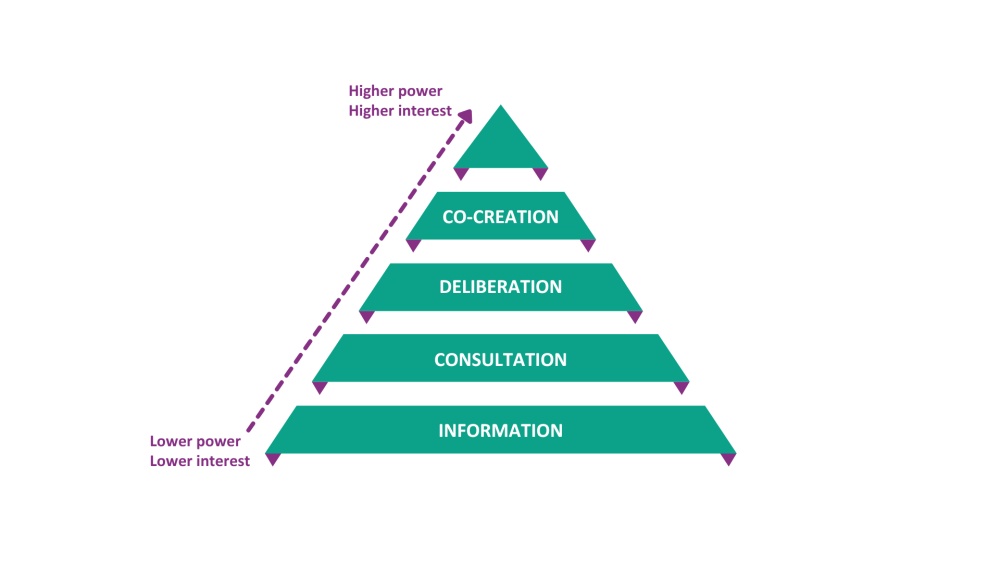
Practices should be positioned along the participation ladder—from information and consultation to deliberation and co‑creation—and combined as needed according to objectives, resources, and timelines, with clear feedback on how inputs shape policies and services; the Ladder of engagement schematic is inserted here to orient these choices.
-
Information: local press, newsletters/posters, social media/online platforms, and websites to promote transparency and trigger participation when well designed and timely.
-
Consultation: surveys and public consultations, public hearings/town halls, focus groups/workshops to elicit aggregated opinions and direct feedback with upfront clarity on use of inputs.
-
Deliberation: deliberative processes, consensus workshops, citizen panels/assemblies to produce informed, collectively legitimated recommendations on complex issues.
-
Co‑creation: citizen science, collaborative bodies/joint policy boards, collective ideation/open innovation, participatory budgets, and foresight methods to share authority in shaping solutions and strategies over longer horizons.