
Content
The OPTAIN project’s optimization concept constitutes a central analytical component of the project. It addresses the challenge of identifying balanced Natural Small Water Retention Measure (NSWRM) implementation strategies under multiple, potentially conflicting objectives within agricultural catchments.
The concept provides a structured decision-support framework for analysing alternative NSWRM configurations. It does not extend to real-world implementation, operational deployment, adaptation or monitoring of measures.
Foundational Principles of the Optimization Concept
The optimization approach is based on the following principles:
Multi-Objective Optimization
NSWRM planning requires balancing several key performance indicators. In OPTAIN case studies, the core objectives considered within the modelling framework were:
-
Water Retention Efficiency
-
Nutrient Retention Efficiency
-
Agricultural Productivity
-
Cost-Effectiveness
These objectives reflect environmental and economic dimensions directly linked to catchment-scale performance and farm-level decision-making.
Catchment-Scale Performance with Field-Scale Decision Variables
The optimization evaluates performance indicators at the catchment scale. However, the decision variables are defined at field scale, representing choices between implementing specific NSWRM types or maintaining current land-use practices. The framework therefore links field-scale decision space with catchment-scale performance outcomes.
Stakeholder-Informed Evaluation
Stakeholder input supports interpretation of optimization results and helps identify preferred trade-offs between competing objectives. Stakeholders contribute to evaluating alternative NSWRM portfolios generated through the analytical process.
Optimization Framework
The OPTAIN optimization framework follows a structured analytical workflow combining simulation modelling and multi-objective optimization algorithms. It includes the following components:
Problem Definition and Objective Setting
Case-study-specific objectives are defined based on measurable catchment-scale performance indicators, typically including water retention efficiency, nutrient retention efficiency, agricultural productivity and cost-effectiveness.
Data Collection and Model Development
Environmental, hydrological and economic data are collected and integrated into modelling tools that simulate the impacts of different NSWRM configurations.
Multi-Objective Optimization Algorithms
Multi-objective optimization algorithms explore combinations of NSWRM implementation options defined at field scale. The algorithms generate sets of Pareto-optimal NSWRM implementation plans representing efficient trade-offs between the defined objectives.
Analysis of Pareto-Optimal Solutions and Derivation of Recommendations
The identified Pareto-optimal solutions are analysed and discussed with stakeholders. This stage supports the identification of preferred NSWRM portfolios and enables the derivation of generalizable insights based on comparative analysis across case studies.
The optimization framework concludes at this stage. It provides analytical outputs and decision-support insights but does not include implementation, operational deployment or monitoring activities.
Key Characteristics of the OPTAIN Optimization Concept
Structured Multi-Objective Analytical Process
The framework systematically evaluates trade-offs between environmental and economic objectives within a defined modelling environment.
Explicit Link Between Decision Space and Performance Indicators
Field-scale implementation choices are connected to catchment-scale performance indicators, ensuring consistency between decision variables and evaluation metrics.
Comparative Insights Across Case Studies
Although conducted separately for each case study, the analytical results allow comparison of optimization outcomes and support the formulation of broader recommendations regarding NSWRM prioritisation.
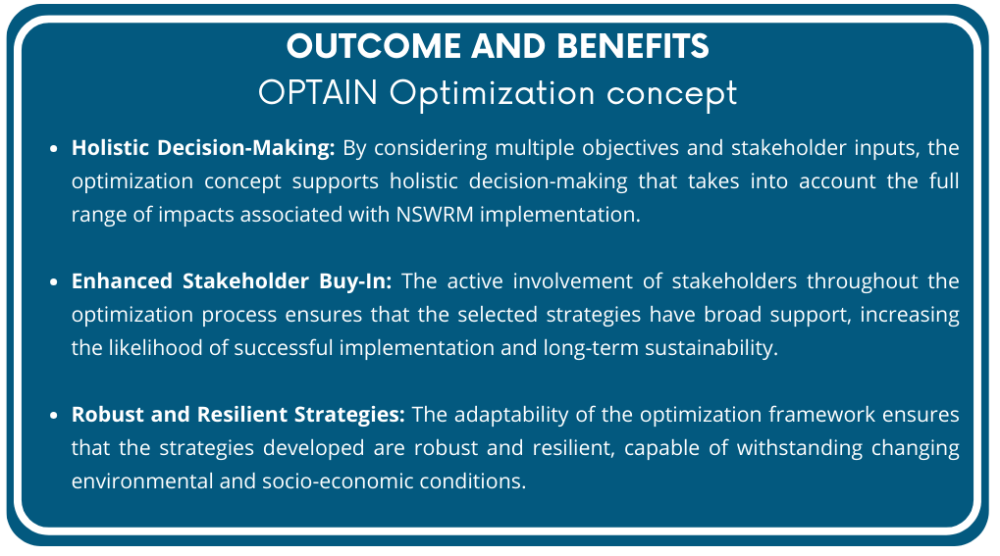
The OPTAIN project's optimization concept represents a comprehensive approach to NSWRM implementation, combining advanced multi-objective optimization techniques with stakeholder engagement and continuous feedback. This approach ensures that the selected strategies are not only effective in achieving their intended goals but also adaptable, sustainable, and aligned with the needs of local communities.