
Content
The concept of Pareto optimality is integral to the optimization strategy employed by the OPTAIN project for implementing Natural Small Water Retention Measures (NSWRM). Pareto optimality refers to a situation where improving one objective in a multi-objective problem cannot be achieved without degrading another objective. In the context of NSWRM, this involves balancing multiple, often competing, goals such as maximizing water retention, minimizing implementation and maintenance costs, enhancing biodiversity, and improving soil health.
Multi-Objective Optimization Process:
In the OPTAIN project, multi-objective optimization techniques are used to generate a range of Pareto optimal solutions, each representing a different trade-off between competing objectives. The process begins by defining the key objectives relevant to NSWRM implementation, such as:
-
Water Retention Efficiency: Maximizing the capacity of measures to retain water and mitigate flood risks.
-
Cost-Effectiveness: Minimizing the costs associated with the implementation and maintenance of NSWRM.
-
Biodiversity Enhancement: Promoting habitat creation and supporting ecological diversity.
-
Soil Health Improvement: Enhancing soil structure and fertility, thereby supporting sustainable agricultural practices.
Development of Pareto Front:
The optimization algorithms used in OPTAIN project generate a Pareto front, which is a set of solutions where no single objective can be improved without compromising another. For example, one solution might achieve the highest possible water retention but at a higher cost, while another might offer a more cost-effective solution with moderate gains in biodiversity and soil health.
The Pareto front provides decision-makers with a spectrum of optimal solutions, each tailored to balance the objectives according to specific priorities. This allows stakeholders to make informed decisions based on the trade-offs they are willing to accept. For instance, a farmer may prioritize cost-effectiveness due to budget constraints, while an environmental agency may focus on maximizing biodiversity gains.
Stakeholder Involvement:
One of the strengths of the Pareto optimal approach in the OPTAIN project is its capacity to incorporate stakeholder preferences and local conditions into the decision-making process. By presenting a range of Pareto optimal solutions, stakeholders can actively participate in selecting the implementation plan that best aligns with their needs and values. This participatory approach ensures that the selected NSWRM strategies are not only technically optimal but also socially acceptable and practically feasible.
Implementation and Adaptation:
Once a Pareto optimal plan is selected, the implementation process is carefully monitored to ensure that the anticipated benefits are realized. The adaptability of Pareto optimal plans is a key advantage, as it allows for adjustments to be made in response to changing environmental conditions or stakeholder priorities. This flexibility is crucial for the long-term sustainability of NSWRM, as it ensures that the measures remain effective and relevant over time.
Tools and Algorithms:
The OPTAIN project employs advanced computational tools and algorithms to handle the complexity of multi-objective optimization. These tools are designed to explore the vast solution space efficiently and to identify the most promising strategies for NSWRM implementation. The algorithms take into account various criterias, including hydrological models, economic constraints, and ecological considerations, to generate solutions that are both robust and adaptable.
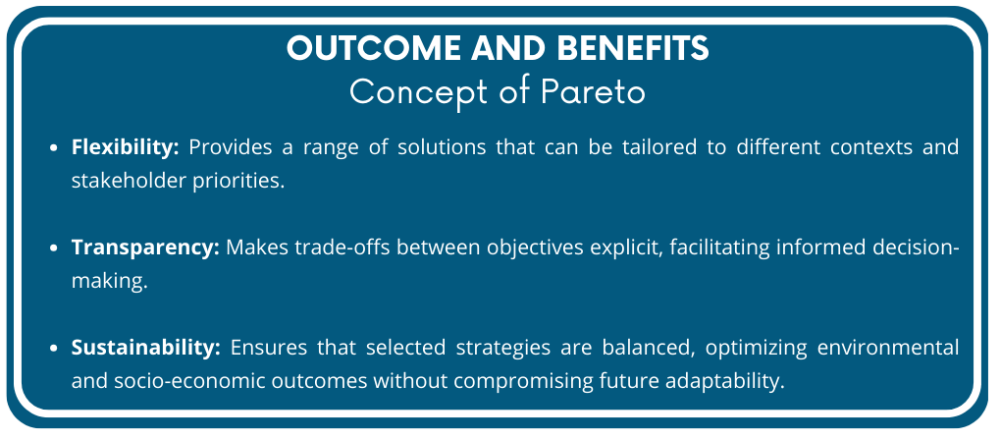
By employing Pareto optimality in the decision-making process, the OPTAIN project ensures that NSWRM strategies are not only effective in the short term but also resilient and sustainable in the long term, capable of adapting to evolving environmental and socio-economic conditions.