- Artificial beaver dams
- Man-made beaver dams
- Beaver Dam Analogs
- Gully stuffing
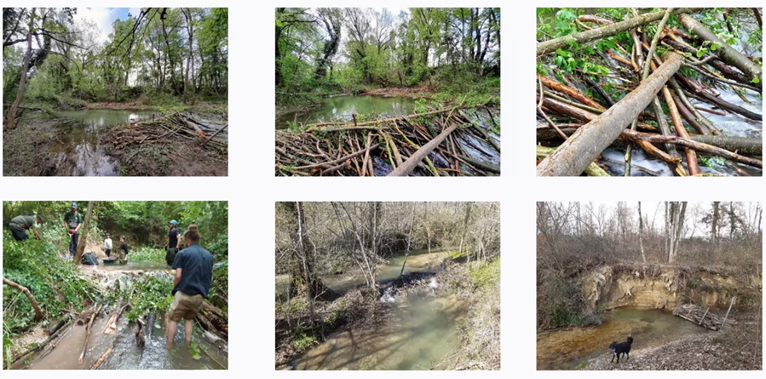
Beaver mimicry structures (BMS), also known as beaver dam analogues (BDAs), are in-stream structures designed to replicate the function of natural beaver dams. These simple, low-tech installations slow streamflow, increase groundwater recharge, favour water diversion in two or more arms, and create wetlands and alluvial forest. By mimicking beaver behaviour, they support biodiversity, improve climate resilience, and help restore degraded waterways. BMS are installed in pairs: the main BMS and a secondary dissipation basin, and often installed in series on a river. They can be installed with local material (wood branches, sediment, sand, stones) and small tools usually used by river workers, and can be easily dismantled within hours if necessary, making them a flexible and reversible habitat management tool.
These structures play a key role in altering local hydrology. By raising the water table and creating ponded areas, BMS promote riparian vegetation growth and provide habitat for aquatic species. On the contrary to impermeable stone or concrete dams, they are permeable for solid transport, especially during flood, and the majority of the water biodiversity including fishes, and do not require fish ladder.
Successful installation typically requires sufficient lateral space to allow for natural water spreading and rewetting of adjacent areas. The system is simple and mobile, as BMS can deteriorate or be washed away during rare flood events. If secondary channels remain intact after flooding, reconstruction may not be necessary. While BMS contribute to natural rewilding, additional restoration work may sometimes be required.
Beaver mimicry is gaining popularity as a cost-effective, non-invasive conservation practice. Even in areas without active beaver populations, BMS effectively replicate their ecological benefits—enhancing water retention, reducing erosion, and supporting broader ecosystem restoration goals.
However, like any restoration intervention, the use of BMS involves trade-offs. While they offer numerous ecological benefits, they may also reduce downstream flow, increase local evaporation and evapotranspiration, or require additional space and monitoring. In some cases, their effects on sediment transport, nutrient cycling, or downstream users may warrant careful evaluation. Therefore, any decision to implement BMS should be made with full awareness of site-specific conditions, goals, and potential consequences, weighing both the pros and cons to ensure sustainable outcomes.
Gully stuffing is similar to the beaver mimicry structure measure. A gully is a landform created by running water; as it passes by, the water forms a trench cut into the land.
If not managed, gullies can be a problem for their surroundings, causing:
- Topsoil loss and agricultural fragmentation,
- Landslides,
- Hydrologic drought and flash flooding,
- Sedimentation and downstream pollution.
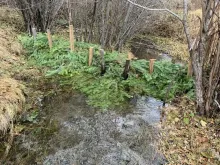
A measure like gully stuffing can reduce water velocity, catch sediment and organic material, stabilize the banks, and raise the water table by strategically packing organic biomass, such as trimmed branches, pine needles or logs, into the channels and gullies.
This measure can be achieved without heavy machinery or concrete; also, by converting cleared brush and forestry waste into functional bio-barriers, gully stuffing offers a cost-effective method to heal eroded watersheds, store carbon, and rebuild resilient landscapes from the ground up.