Last update
2025
Summary
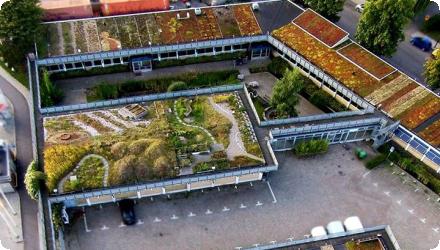
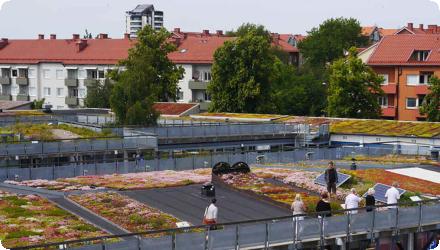
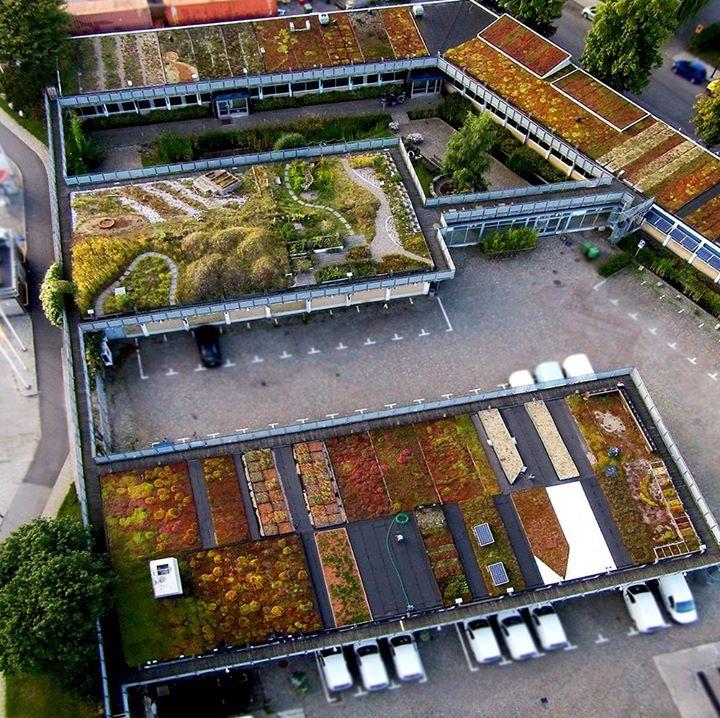
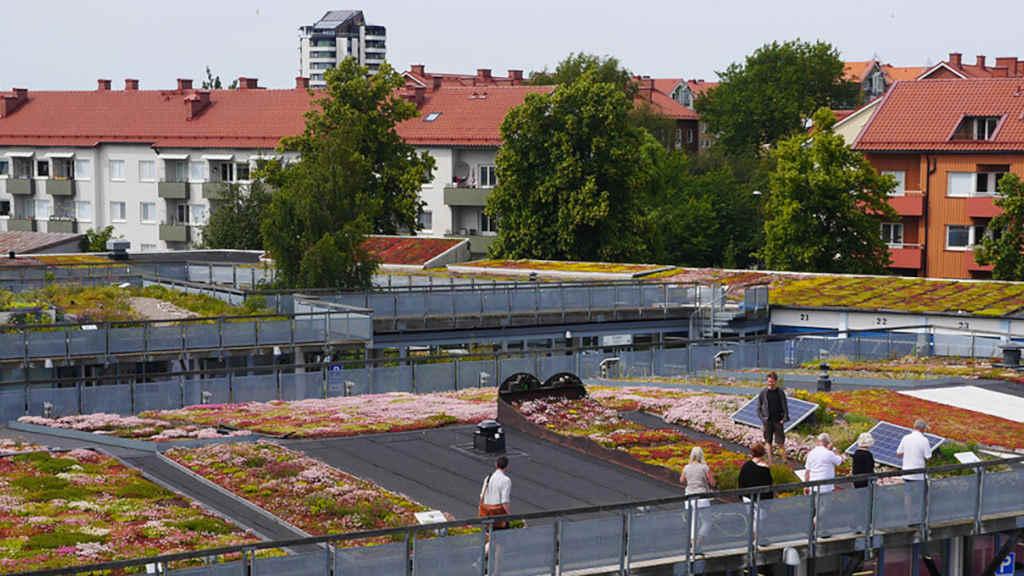
Augustenborg’s Botanical Roof Garden is a large, publicly accessible green roof complex built within the Eco-city Augustenborg regeneration in Malmö. It was created to reduce local flooding and to add green space and wellbeing benefits in a district facing social challenges. The City of Malmö led and funded the installation. The Scandinavian Green Roof Institute provided maintenance and outreach. SLU and Lund University carried out long-term monitoring.
About 9,500 m² of extensive roofs were implemented on buildings with low load capacity, following Agenda 21 principles for local stormwater management. The roof garden was tied to the wider Ekostaden programme alongside open stormwater elements at ground level.The botanical roof garden opened to the public in 2001 as part of the award-winning Eco-city Augustenborg project.
Hydrologic performance has been documented on thin sedum-moss systems typical of southern Sweden. Monthly water balance studies show much lower annual runoff than hard roofs due to evapotranspiration. Field capacity is about 9 mm. For peaks, a 1.5-year runoff corresponds to only a 0.4-year rain, indicating strong detention. At the district scale, the regeneration report states that green roofs intercept roughly half of total annual runoff.
Vegetation studies on similar Malmö-region roofs found sedum dominance and limited spontaneous diversity in unfertilised thin systems. Over 2 to 22 years, substrates accumulate nitrogen, with estimated gains around 2.9 g N/m²/yr, while plant biomass and diversity remain broadly stable.
Governance and financing sat with the City of Malmö, complemented by national funds, LIFE and research councils. Community discussions accompanied the broader open stormwater redevelopment, with some concerns about space use and perceived costs. A local assessment notes costs were not higher than rebuilding underground drainage, though operating costs can be higher and co-benefits are hard to monetise.
Today, formal maintenance is very limited and the roof garden project itself is reported as closed, while research on Augustenborg-type roofs continues through universities.
About 9,500 m² of extensive roofs were implemented on buildings with low load capacity, following Agenda 21 principles for local stormwater management. The roof garden was tied to the wider Ekostaden programme alongside open stormwater elements at ground level.The botanical roof garden opened to the public in 2001 as part of the award-winning Eco-city Augustenborg project.
Hydrologic performance has been documented on thin sedum-moss systems typical of southern Sweden. Monthly water balance studies show much lower annual runoff than hard roofs due to evapotranspiration. Field capacity is about 9 mm. For peaks, a 1.5-year runoff corresponds to only a 0.4-year rain, indicating strong detention. At the district scale, the regeneration report states that green roofs intercept roughly half of total annual runoff.
Vegetation studies on similar Malmö-region roofs found sedum dominance and limited spontaneous diversity in unfertilised thin systems. Over 2 to 22 years, substrates accumulate nitrogen, with estimated gains around 2.9 g N/m²/yr, while plant biomass and diversity remain broadly stable.
Governance and financing sat with the City of Malmö, complemented by national funds, LIFE and research councils. Community discussions accompanied the broader open stormwater redevelopment, with some concerns about space use and perceived costs. A local assessment notes costs were not higher than rebuilding underground drainage, though operating costs can be higher and co-benefits are hard to monetise.
Today, formal maintenance is very limited and the roof garden project itself is reported as closed, while research on Augustenborg-type roofs continues through universities.
Position
Latitude
55.577
Longitude
13.027
Project
NWRM
Installation date
1999–2001
Implementation Status
Contact
City of Malmö (building owner; manager of installation).
Transboundary
0
Photo gallery
Location of the project
Augustenborg district, City of Malmö, Skåne County, Sweden.
NUTS Code
SE22 - Sydsverige
Project's objectives
Reduce local flooding
Increase wellbeing and green space.
Increase wellbeing and green space.
Involved Partners
| Authority type | Authority name | Role | Comments |
|---|---|---|---|
Climate zone
cool temperate dry
Temperature
9.2°C
Precipitation
652
Annual rainfall range
600 - 900 mm
Elevation range
18 m
Vegetation class
Sedum-moss succulents; mixtures tested and monitored at Augustenborg roof plots.
Water bodies: Ecological Status
Moderate
Water bodies: Chemical Status
Failing to achieve good
Project scale
Micro
Project scale specification
site/district roof complex
Project area
9,500 m²
Local stormwater treatment under the Agenda 21 umbrella; designed under low weight-bearing constraints of existing buildings.
low load-bearing capacity of the buildings
Total cost
unknown
Financing authorities
Type of funding
Local funds
Type of funding
National funds
Type of funding
EU-funds: LIFE+
Type of funding
Other
Compensations
0
Policy context
In the 1980s and 1990s, Malmö, Sweden, was a physically dilapidated, economically challenged, and socially deprived region. Floods routinely impacted the area because the drainage system was inadequate. Health problems were severe and unemployment was high. Approach: In 1998, the Augustenborg District in Malmö initiated an extensive urban renovation program under the name of Ekostaden (econeighborhood). Under this approach, officials sought to recreate the area as an integrated whole and to transform it into an ecologically, socially, and economically sustainable city district. Collaborating with area residents and other stakeholders, local officials succeeded in building a new neighborhood with public space and community-run cafes and activities. One of the most important features of this initiative was the use of green roofs to solve some of the flooding problems the area faced. The green roofs have been highly effective in capturing runoff, and on average intercept half of the total runoff over the course of a year. A botanical roof garden covers 9,000 m2 of the industrial area and contributes to the flood risk reduction efforts.
Land ownership
City of Malmö
Community involvment
Yes
Design consultation activity
| Activity stage | Name | Key issues | Comments |
|---|---|---|---|
|
Implementation phase
|
There were a lot of discussion regarding the redevelopment of courtyards and the open stormwater system.
|
Policy target
| Target purpose |
|---|
Target Remarks
Mitigate local flooding; increase green space and wellbeing.
Policy pressure
| Pressure directive | Relevant pressure |
|---|
Pressures remarks
Local flooding
Policy impact
| Impact directive | Relevant impact |
|---|
Impact remarks
Area-wide runoff reduced; biodiversity increased; enhanced public realm (district level).
Requirement directive
| Requirement directive | Specification |
|---|
Contractual arrangements
0
| Arrangement type | Responsibility | Role | Name | Comments |
|---|
Part of wider plan
0
Wider plan type
| Wider plan type | Wider plan focus | Name | Comments |
|---|---|---|---|
|
Local
|
Water
|
Eco-city Augustenborg
|
Local urban regeneration and water management plan. Integration with open stormwater system and green roofs at district scale.
|
More than 20 years of studies on stormwater runoff, vegetation development, and stormwater quality by SLU, LTH and partners.
Maintenance
Very limited at present; previously maintained by the Scandinavian Green Roof Institute (now closed).
Empirical monitoring on the roof garden and related roofs; peer-reviewed studies underpin hydrologic and ecological findings.
Multiple benefits, but difficult to isolate from wider city transformation during the same period.
Flood mitigation through runoff reduction and detention. Added urban green space and habitat.
Employement in the area.
Flood mitigation through runoff reduction and detention. Added urban green space and habitat.
Employement in the area.
Trade-offs of open stormwater elements at ground level: space use near homes, perception of high costs vs other needs.
Information on retained water
At district scale, green roofs intercept roughly half of annual runoff. For the roof type studied in southern Sweden (sedum-moss, ~3 cm), peak flows are significantly attenuated: runoff with a 1.5-year return period corresponds to only a 0.4-year rain, indicating strong detention. An evaluation (Kibirige and Tan 2013) concluded that the “open stormwater system in Augustenborg is well suited to handle current climatic conditions and a 10 year extreme event.
Information on Water quality overall improvements
Green roof ecosystem development shows long-term N accumulation along a chronosequence in southern Sweden roofs.
Biodiversity increased in the area; the Botanical Roof Garden attracted birds and insects.
Key lessons
Joint work by all involved parties was crucial, with periods when participants felt like quitting. This level of commitment underpinned delivery over time. Obstacles were extensive across physical, technical, human and regulatory aspects. Low load-bearing capacity of the buildings strongly constrained design options.
Community acceptance required substantial discussion around courtyard redevelopments and the open stormwater system. Open elements occupy space near homes and were perceived as costly, competing with other priorities.
Maintenance is currently very limited; the garden was previously maintained by the Scandinavian Green Roof Institute. The roof garden project itself is now closed. However, long-term monitoring has provided evidence on runoff, vegetation development and water quality for over two decades, supporting learning from the site.
Community acceptance required substantial discussion around courtyard redevelopments and the open stormwater system. Open elements occupy space near homes and were perceived as costly, competing with other priorities.
Maintenance is currently very limited; the garden was previously maintained by the Scandinavian Green Roof Institute. The roof garden project itself is now closed. However, long-term monitoring has provided evidence on runoff, vegetation development and water quality for over two decades, supporting learning from the site.
Success factor(s)
| Success factor type | Success factor role | Comments | Order |
|---|---|---|---|
|
Successful coordination between authorities
|
main factor
|
The joint work by all involved parties was a so very important for the success. There were times when everyone was feeling like quitting. |
Driver
| Driver type | Driver role | Comments | Order |
|---|---|---|---|
|
Past flooding events
|
main driver
|
Local flooding problems
|
Transferability
This large, integrated model is difficult to transfer wholesale; specific technical solutions such as green roofs have diffused widely. Some technical solutions live on and green roofs have certainly taken off, but the project as a whole must be seen as unique.
Cost effectiveness
Not more expensive than remodelling an underground stormwater system; running costs may be higher, with co-benefits that are hard to monetise.
English