- Minimum till agriculture
- No till agriculture
- No tillage
- Low till agriculture
- Low tillage
- Reduced Tillage
- Zero Tillage
- Strip tilling
- Direct seeding
Tillage is a mechanical modification of the soil. Intensive tillage can disturb the soil structure, thus increasing erosion, decreasing water retention capacity, reducing soil organic matter through the compaction and transformation of pores. Minimum tillage covers practices that reduce soil disturbance and keep crop residues on the surface. It improves infiltration, protects soil structure, limits erosion and preserves moisture by maintaining residue mulch and macropores. It typically lowers machinery passes and fuel use and can enhance soil biological activity and organic matter. Hydrologically, it slows and shortens surface flow paths and increases rainwater entry into the profile.
No-till agriculture
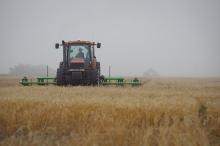
No-tillage (or zero tillage) is a minimum tillage practice in which the crop is sown directly into soil not tilled since the harvest of the previous crop.This practice enhances soil health by increasing water infiltration, retaining organic matter, cycling nutrients, and reducing soil erosion. The primary benefits include improved soil biological fertility, reduced erosion, and enhanced soil moisture retention. The most powerful benefit of no-tillage is improvement in soil biological fertility, making soils more resilient. In both conventional and organic no-till systems, the protection and minimal disturbance of topsoil decrease soil erosion rates. The vegetation detritus acts as mulch, retaining soil moisture, providing nutrition as it decomposes, and suppressing weeds. Additionally, no-till agriculture reduces the need for equipment, fuel, and fertilizers, while improving soil structure, microbial activity, and water infiltration. No-till practices have gained attention for carbon sequestration, helping mitigate greenhouse gas emissions. Crops suited to this technique include corn, small grains, pigeon pea, cowpea, and soybean.
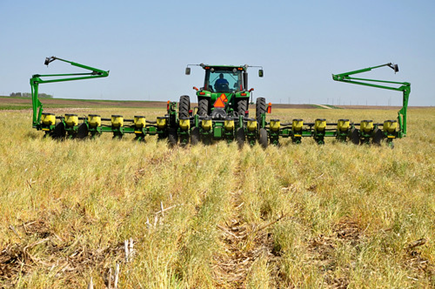
A no-till planter used to plant soybeans (US)
Source : Jason Johnson, NRCS-Iowa
Low-till agriculture (reduced tillage)
Low till agriculture, also known as conservation or reduced till applies to arable land. It consists of a combination of a crop harvest which leaves at least 30% of crop residue on the soil surface, during the critical soil erosion period and some surface work (low till). This slows water movement, which reduces the amount of soil erosion and potentially leads to greater infiltration. Low-till or reduced tillage involves shallow soil disturbances, such as chiselling, strip-till, or direct seeding, while maintaining at least 30% surface residue cover. This approach reduces runoff and erosion, though not as effectively as No-tillage, but it may strike a balance in wetter climates where no-tillage risks excessive moisture retention. Additionally reduced tillage enhances the soil's "sponge functions" like water regulation and infiltration by improving macropore stability.
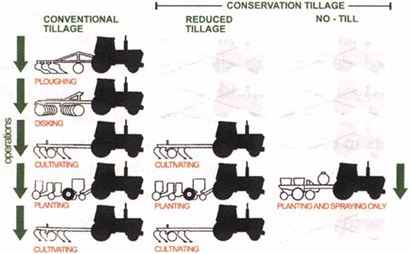
Conventional vs Conservation Tillage
Strip Tilling
A reduced tillage system: only narrow strips are tilled where the seed will be placed; inter-row remains untilled and residue-covered. Lowers overall soil disturbance, maintains residue between rows, reduces erosion vs full-width tillage, can improve trafficability and row-zone infiltration. Parallel tilled bands, commonly GPS-guided; orientation may be on the contour or not, depending on the system.