Last update
2025
Summary
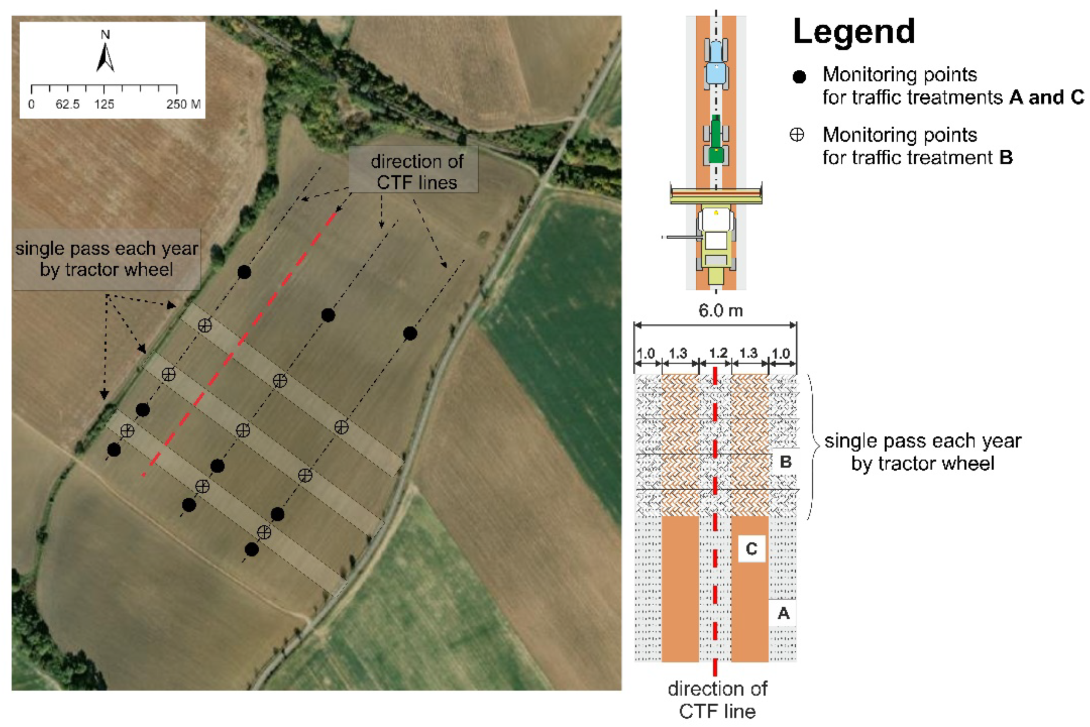
This case study documents a long-term Controlled Traffic Farming (CTF) experiment on a 16 ha steep arable field operated by the Slovak University of Agriculture near Kolíňany, Nitra Region, Western Slovakia. CTF was introduced in 2009 and the field-scale layout was established in 2010 using a 6 m machinery module with permanent tramlines. The design confines wheel traffic to fixed lanes so that about half the field remains traffic-free. Slopes are mostly 3 to 7 % on silt-loam soils in a continental climate.
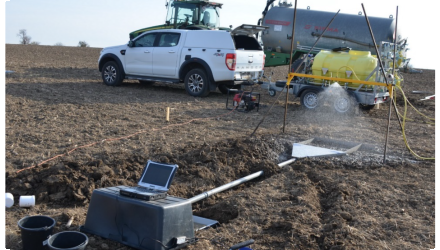
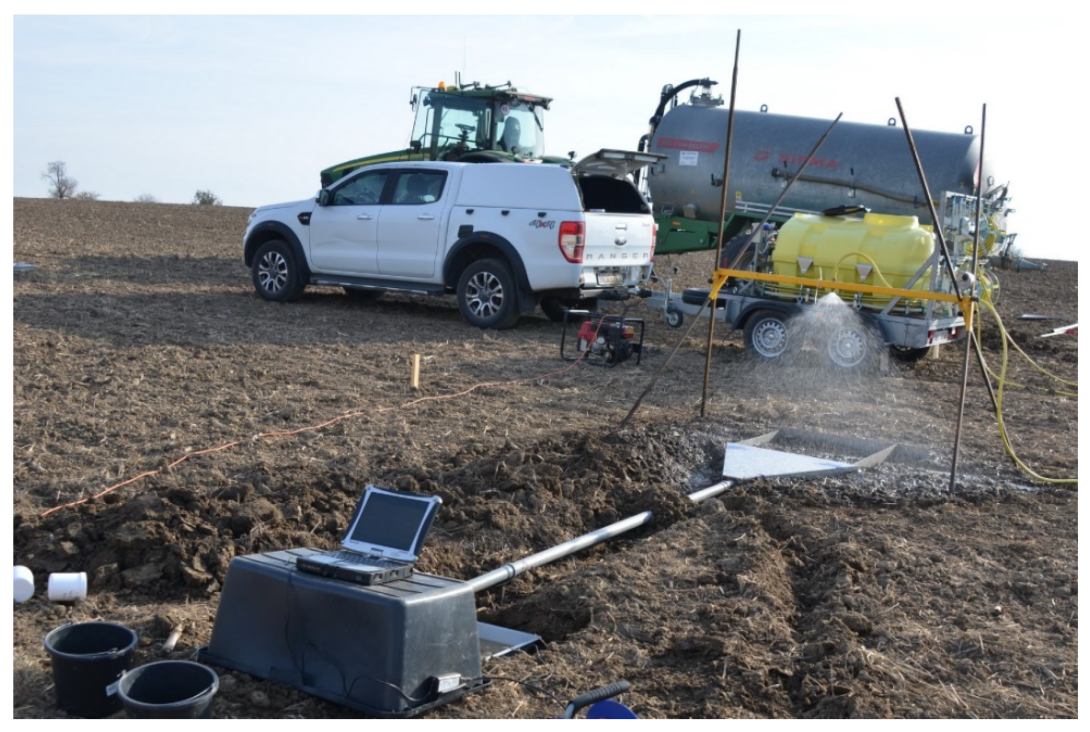
The objective was to test whether confining traffic reduces rainfall-induced runoff and soil loss under Central European conditions. The team combined erosion risk mapping using USLE and RUSLE with targeted field measurements. In 2021 they used a rainfall simulator on three locations representing different traffic intensities. They also assessed soil physical condition using a cone penetrometer.
Results show that the no-traffic area showed the lowest runoff, with runoff intensity after 20 min about ten times lower than in the multiple-traffic area. Total sediment collected after 35 minutes was about 70 % lower in no-traffic than in single-pass, and only a quarter of the multiple-pass loss. Across the 16 ha field, modelling indicated that roughly 30 % of the area has a potential annual soil loss of 5 to 15 t ha⁻¹, which aligns with Slovak regulatory thresholds. The traffic-free strips consistently exhibited better structure and infiltration, confirming the mechanism behind reduced runoff.
Implementation factors that supported performance include permanent tramlines perpendicular to slope, a consistent 6 m module, and continuity of the layout over more than a decade. The study also notes that European adoption often follows a tiered pathway, from low-cost layout conversion using existing machinery to wider modules that require equipment changes. While detailed costs for this site are not provided, prior European analyses show potential payback from yield and tillage savings as systems scale. Overall, the case provides robust, Central Europe-specific evidence that CTF can substantially reduce runoff and soil loss on sloping cropland when tramlines are maintained and operations are aligned to the layout.
The objective was to test whether confining traffic reduces rainfall-induced runoff and soil loss under Central European conditions. The team combined erosion risk mapping using USLE and RUSLE with targeted field measurements. In 2021 they used a rainfall simulator on three locations representing different traffic intensities. They also assessed soil physical condition using a cone penetrometer.
Results show that the no-traffic area showed the lowest runoff, with runoff intensity after 20 min about ten times lower than in the multiple-traffic area. Total sediment collected after 35 minutes was about 70 % lower in no-traffic than in single-pass, and only a quarter of the multiple-pass loss. Across the 16 ha field, modelling indicated that roughly 30 % of the area has a potential annual soil loss of 5 to 15 t ha⁻¹, which aligns with Slovak regulatory thresholds. The traffic-free strips consistently exhibited better structure and infiltration, confirming the mechanism behind reduced runoff.
Implementation factors that supported performance include permanent tramlines perpendicular to slope, a consistent 6 m module, and continuity of the layout over more than a decade. The study also notes that European adoption often follows a tiered pathway, from low-cost layout conversion using existing machinery to wider modules that require equipment changes. While detailed costs for this site are not provided, prior European analyses show potential payback from yield and tillage savings as systems scale. Overall, the case provides robust, Central Europe-specific evidence that CTF can substantially reduce runoff and soil loss on sloping cropland when tramlines are maintained and operations are aligned to the layout.
Position
Latitude
18.2066
Longitude
48.3559
Installation date
2009
Implementation Status
Contact
Institute of Agricultural Engineering, Transport and Bioenergetics, Faculty of Engineering, Slovak University of Agriculture in Nitra
Transboundary
0
Photo gallery
Location of the project
University Farm area near Kolíňany, Nitra District, Nitra Region, Slovakia
NUTS Code
SK02 - Západné Slovensko
Project's objectives
Reduce water runoff and soil loss on steep arable land by confining traffic to permanent lanes and improving infiltration.
Involved Partners
| Authority type | Authority name | Role | Comments |
|---|---|---|---|
Climate zone
cool temperate moist
Temperature
10.29 °C
Precipitation
416 mm
Elevation range
196–212 m a.s.l.
Slope range
Mostly 3-7 % ; field range about 1-12 °
Water bodies: Ecological Status
Moderate
Water bodies: Chemical Status
Failing to achieve good
Soil quality
Water erosion risk on steep land.
Project scale
Micro
Project scale specification
site experiment on a single field.
Project area
16 ha
Lifespan
Ongoing as long as CTF layout is maintained.
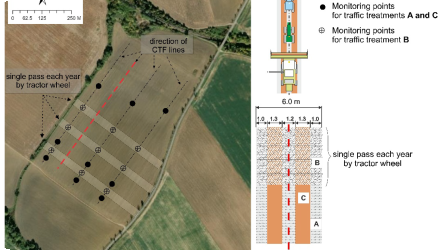
Permanent tramlines confining traffic to about 24 percent of the area; single-pass strips about 39 percent; no-traffic area about 55 percent. Tramlines laid perpendicular to slope. 6 m machinery module.
Steep arable field with 3-7 % slopes, silt-loam soils, continental climate; orientation of tramlines relative to slope influences runoff. Matched machinery widths and permanent tramlines to confine traffic; layout perpendicular to slope at this site.
Total cost
unknown
Financing authorities
Type of funding
EU-funds: Cohesion and regional development funds
Comments
Operational Programme Integrated Infrastructure, project “Sustainable smart farming systems…” 313011W112.
Type of funding
Other
Policy context
Slovak legislation referenced maximum allowable soil loss 15 t ha⁻¹ yr⁻¹ in analysis. Wider EU policy links not specified.
Land ownership
University Farm Kolíňany (SUA).
Community involvment
No
Target Remarks
Reduce rainfall-induced runoff and soil loss on steep arable land under Central European conditions.
Pressures remarks
Water erosion on cultivated slopes.
Contractual arrangements
0
| Arrangement type | Responsibility | Role | Name | Comments |
|---|---|---|---|---|
Part of wider plan
0
Wider plan type
| Wider plan type | Wider plan focus | Name | Comments |
|---|---|---|---|
Targeted field campaigns using a rainfall simulator and runoff collection, plus USLE/RUSLE modelling and cone-penetrometer surveys in 2021.
USLE and RUSLE for potential soil loss mapping; in situ runoff and sediment sampling; cone-penetrometer measurements with ANOVA.
Reduced soil loss for farming land.
Information on retained water
In rainfall-simulator tests, no-traffic area had the lowest runoff; after 20 min runoff intensity was about 10 times lower vs multiple-traffic area. Onset of runoff was delayed in no-traffic area.
Information on Water quality overall improvements
Total sediment yield after 35-40 min was 70 % lower in no-traffic area vs single-pass, and 75 % lower vs multiple-traffic area.
Lower cone-penetrometer resistance in topsoil under no-traffic area; statistical differences at p < 0.05.
Lower cone-penetrometer resistance in topsoil under no-traffic area; statistical differences at p < 0.05.
Key lessons
CTF on steep Central European arable land can markedly reduce runoff and soil loss when permanent tramlines are maintained.
Success factor(s)
| Success factor type | Success factor role | Comments | Order |
|---|---|---|---|
|
Conducted assessments (incl. economic)
|
secondary factor
|
Long-term continuity of the layout
|
|
|
Available support tools
|
main factor
|
Availability of GNSS and machinery layout enabling CTF.
|
Driver
| Driver type | Driver role | Comments | Order |
|---|---|---|---|
|
Organisation committed to it
|
main driver
|
Research need to address erosion
|
Flexibility adaptability
Tiered adoption pathway in Europe from low-cost conversion to full 8 m modules suggests transferability; results align with UK and Australia studies. In Europe adoption is limited and often requires machinery coordination or replacement.
English