The sponge functions of a landscape refer to its ability to soak up, store and slowly release water.
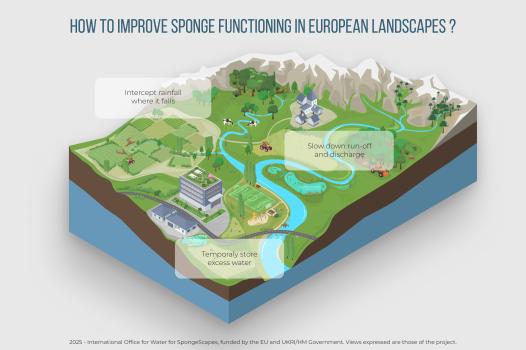
It is possible to distinguish 3 sponge functions:
1. Intercept rainfall where it falls and stimulate infiltration into the soil;
2. Slow down the runoff that has formed on the surface, is drained from groundwater, or is accumulated in streams;
3. Temporarily store excess water in the soil, groundwater or surface water bodies.
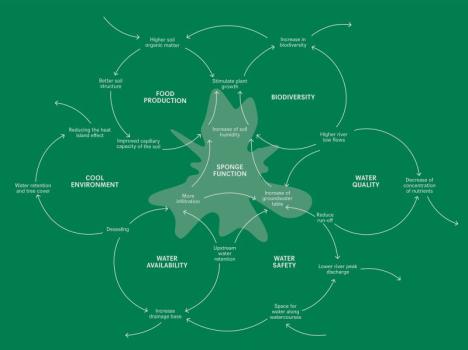
Sponge functions of a territory play the role of regulator of water. They lie at the heart of a complex system of interconnected physical processes, binding all actors and sectors together (see illustration scheme). The parameters within these sponge loops are numerous. We have become champions at monitoring them separately in every sector, while clearly seeing that they are intrinsically linked. If we organize ourselves to positively activate sponge loops, we unlock a chain reaction of benefits in favour of water availability, quality, safety, food production and biodiversity, all at once.
Sponge functions are context-specific and must be evaluated for a myriad of different hydrometeorological events, ranging from annual floods and droughts to more extreme events. The greater the sponge functions in the landscape, the more rainwater can be stored and/or used by vegetation, and surface runoff slowed, thus reducing or avoiding flooding downstream. However, it is important to note that sponge functions are not unlimited. Once full, a sponge can no longer store water to reduce the impact of floods, and once empty, it can no longer provide water in the event of a drought, yet for more frequently occurring events, this approach will contribute to the reduction of impacts both in space and time.