Last update
2026
Summary
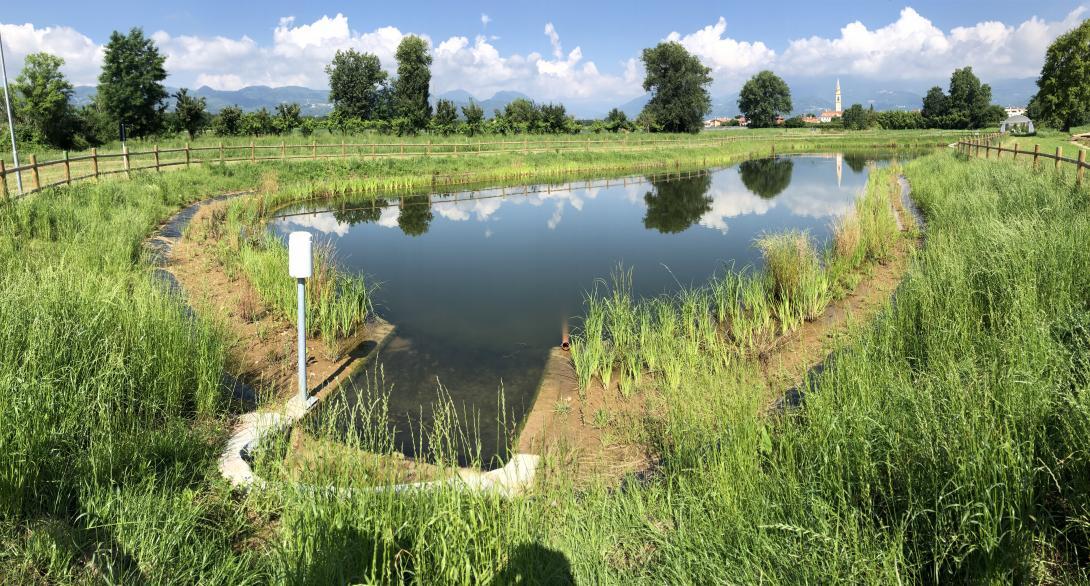
The Timonchio Retention Pond was implemented in 2019 within the LIFE BEWARE project as an innovative response to increasing drought risk and climate variability in an agricultural landscape. The intervention consists of a retention pond covering approximately 0.295 ha and connected to a watershed of around 110 ha.
The pond was designed to store runoff during wet periods and make water available for agricultural uses during drought conditions, while simultaneously reducing flood risks and creating new ecological habitats. The measure directly benefits approximately 16 ha of agricultural land through improved irrigation reliability.
The project emerged from strong cooperation among public authorities, farmers and water managers, demonstrating how collaborative governance can facilitate the implementation of nature-based solutions in agricultural areas.
The pond was designed to store runoff during wet periods and make water available for agricultural uses during drought conditions, while simultaneously reducing flood risks and creating new ecological habitats. The measure directly benefits approximately 16 ha of agricultural land through improved irrigation reliability.
The project emerged from strong cooperation among public authorities, farmers and water managers, demonstrating how collaborative governance can facilitate the implementation of nature-based solutions in agricultural areas.
Position
Latitude
45.695
Longitude
11.405833333333334
Biogeographical Region
Continental
Project
SpongeScapes
Installation date
2019
Implementation Status
Transboundary
0
Photo gallery
Location of the project
The Timonchio site (see case studies "Municipality of Santorso sites, Italy" and "Agripolis site, Italy) is located near the Venetian Pre-Alps, crossed by the Leogra and the Timonchio rivers and artificial channels crucial for historical manufacturing, irrigation, and runoff control. The case study is located in the Veneto region that signed the Mission Charter of the EU Mission on Climate Adaptation.
Project's objectives
The main objective of these case studies is to analyse the impacts of the widespread adoption of the sponge measures in such a heterogeneous, anthropised environment. The co-benefits and trade-offs associated with these interventions will also be analysed, taking into account their economic implications for local stakeholders.
Involved Partners
| Authority type | Authority name | Role | Comments |
|---|---|---|---|
Costs investment information
Initial investment: €184 000 for construction.
Annual expenses: €17 190 =
-> Routine vegetation maintenance: mowing costs 12 690 €/year
-> Ordinary maintenance: cleaning and sluice management 3 500 €/year
-> Extraordinary cleaning: cleaning interventions 1 000 €/year
Long term expense: There is a long-term extraordinary maintenance cost of €25,000 every 30 years for geomembrane replacement.
Ongoing costs: Regular monitoring costs are expected to be high but have not yet been quantified.
Annual expenses: €17 190 =
-> Routine vegetation maintenance: mowing costs 12 690 €/year
-> Ordinary maintenance: cleaning and sluice management 3 500 €/year
-> Extraordinary cleaning: cleaning interventions 1 000 €/year
Long term expense: There is a long-term extraordinary maintenance cost of €25,000 every 30 years for geomembrane replacement.
Ongoing costs: Regular monitoring costs are expected to be high but have not yet been quantified.
Financing authorities
Community involvment
No
Design consultation activity
| Activity stage | Name | Key issues | Comments |
|---|---|---|---|
Policy target
| Target purpose |
|---|
Policy pressure
| Pressure directive | Relevant pressure |
|---|---|
Policy impact
| Impact directive | Relevant impact |
|---|---|
Requirement directive
| Requirement directive | Specification |
|---|---|
Contractual arrangements
0
| Arrangement type | Responsibility | Role | Name | Comments |
|---|---|---|---|---|
Part of wider plan
0
Wider plan type
| Wider plan type | Wider plan focus | Name | Comments |
|---|---|---|---|
The basin has been monitored since 2020 to analyse its effectiveness in flood mitigation.
The Timonchio retention pond provides approximately 2,288 m³ of storage capacity and supplies water to around 16 ha of agricultural land, thus enhancing agricultural resilience. By increasing water availability during drought periods, the intervention reduces farmers’ vulnerability to climate extremes and helps maintain agricultural productivity. Some estimates (source: Project LIFE) claim that avoided drought-related losses may exceed €250,000 during severe drought events, highlighting the significant economic value of water retention measures.
The retention pond has generated substantial ecosystem services, including ecological improvements alongside its water management functions.
The measure has generated substantial biodiversity improvements through the creation of aquatic and riparian habitats. Monitoring activities documented the establishment of eight new bird species and four amphibian species, together with the planting of more than 2,200 native plants. These results demonstrate the capacity of water retention measures to support habitat restoration and biodiversity conservation.
The intervention also contributes to flood risk reduction by temporarily storing runoff during heavy rainfall events, providing benefits to downstream communities and agricultural land.
The retention pond has generated substantial ecosystem services, including ecological improvements alongside its water management functions.
The measure has generated substantial biodiversity improvements through the creation of aquatic and riparian habitats. Monitoring activities documented the establishment of eight new bird species and four amphibian species, together with the planting of more than 2,200 native plants. These results demonstrate the capacity of water retention measures to support habitat restoration and biodiversity conservation.
The intervention also contributes to flood risk reduction by temporarily storing runoff during heavy rainfall events, providing benefits to downstream communities and agricultural land.
-> Aquatic Habitat Restoration: Restored habitat area (0.295 ha)
-> Riparian Habitat Restoration: Included in project area
-> Biodiversity Enhancement: + 12 species
-> Vegetation Restoration: 2,200 plants of 8 species
-> Riparian Habitat Restoration: Included in project area
-> Biodiversity Enhancement: + 12 species
-> Vegetation Restoration: 2,200 plants of 8 species
Success factor(s)
| Success factor type | Success factor role | Comments | Order |
|---|---|---|---|
|
Attitude of relevant stakeholders
|
main factor
|
The most important success factor was the strong collaboration established among farmers, the Municipality of Marano Vicentino and the Alta Pianura Veneta Reclamation Consortium. Clear agreements regarding land availability, construction responsibilities and long-term management enabled the intervention to be implemented efficiently and accepted by local stakeholders.
|
Driver
| Driver type | Driver role | Comments | Order |
|---|---|---|---|
|
Past flooding events
|
main driver
|
In Veneto, Italy, floods, landslides, and erosion have significantly affected the region. Municipalities face increased flood risks due to rising land consumption, more in northern Italy. Santorso and Marano Vicentino, in Vincenza's north, use sponge measures to counter pluvial flooding and improve rainwater management.
|
Transferability
Recommendations for Replication:
Future projects should prioritise stakeholder engagement from the earliest planning stages and establish clear maintenance responsibilities before implementation. Particular attention should be devoted to ecological design and species selection, as these decisions strongly influence long-term performance and maintenance requirements.
Policy Recommendations:
Dedicated funding schemes are needed to support post-project monitoring and maintenance. Policy frameworks should also encourage collaborative governance arrangements involving farmers, municipalities and water authorities, which proved essential for the success of this intervention.
Future projects should prioritise stakeholder engagement from the earliest planning stages and establish clear maintenance responsibilities before implementation. Particular attention should be devoted to ecological design and species selection, as these decisions strongly influence long-term performance and maintenance requirements.
Policy Recommendations:
Dedicated funding schemes are needed to support post-project monitoring and maintenance. Policy frameworks should also encourage collaborative governance arrangements involving farmers, municipalities and water authorities, which proved essential for the success of this intervention.
English
-> Project promoter.