Last update
2026
Summary
County Wicklow faces increasing challenges related to climate change, flood risk, and biodiversity loss due to land-use pressures and hydrological changes. The project seeks to address these challenges through the implementation of sponge measures that enhance water retention, improve flood resilience, and support biodiversity conservation.
The initiative includes the development of a Sponge Strategy and Action Plan for the entire project area, learning from the experiences of our demonstration region, the Lèze river basin in France, and through collaboration with other project partners.
The project has three core focus areas, i) water retention in upland wetlands, ii) water retention in farming landscapes, iii) and nature-based solutions for the urban environment.
A key output will be the demonstration initiative in the Derry water sub-catchment. This pilot will involve working with landowners to trial sponge measures, proved elsewhere and adapted to local farming needs. A strategy will be developed to provide a framework for best practice in engaging the farming community and promoting the wider adoption of nature-based solutions.
To complement rural interventions, the project will include urban engagement in Aughrim, working with the community to identify and implement measures such as rain gardens, permeable paving, and detention basins to mitigate urban runoff and enhance local climate resilience.
The project will also conduct a catchment-wide scoping assessment to map ongoing initiatives, identify gaps, and highlight new opportunities for sponge measures. Finally, a strong knowledge-sharing component will ensure that lessons learned are disseminated widely, supporting replication in other regions and embedding sponge strategies into long-term land and water management planning.
Through this multi-faceted approach, Wicklow County Council and its partners will demonstrate the feasibility, scalability, and long-term benefits of sponge measures in an Irish context, supporting EU climate, soil and water missions.
The initiative includes the development of a Sponge Strategy and Action Plan for the entire project area, learning from the experiences of our demonstration region, the Lèze river basin in France, and through collaboration with other project partners.
The project has three core focus areas, i) water retention in upland wetlands, ii) water retention in farming landscapes, iii) and nature-based solutions for the urban environment.
A key output will be the demonstration initiative in the Derry water sub-catchment. This pilot will involve working with landowners to trial sponge measures, proved elsewhere and adapted to local farming needs. A strategy will be developed to provide a framework for best practice in engaging the farming community and promoting the wider adoption of nature-based solutions.
To complement rural interventions, the project will include urban engagement in Aughrim, working with the community to identify and implement measures such as rain gardens, permeable paving, and detention basins to mitigate urban runoff and enhance local climate resilience.
The project will also conduct a catchment-wide scoping assessment to map ongoing initiatives, identify gaps, and highlight new opportunities for sponge measures. Finally, a strong knowledge-sharing component will ensure that lessons learned are disseminated widely, supporting replication in other regions and embedding sponge strategies into long-term land and water management planning.
Through this multi-faceted approach, Wicklow County Council and its partners will demonstrate the feasibility, scalability, and long-term benefits of sponge measures in an Irish context, supporting EU climate, soil and water missions.
Photo gallery
Location of the project
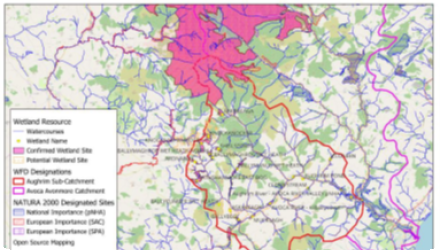
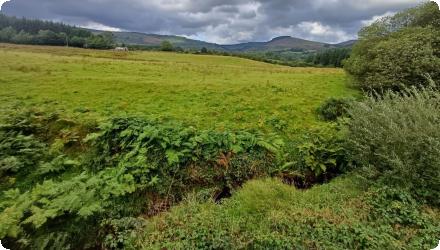
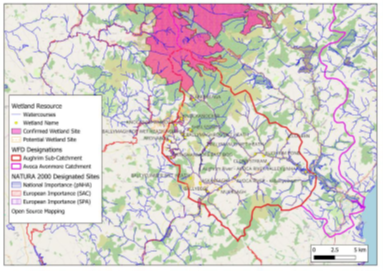
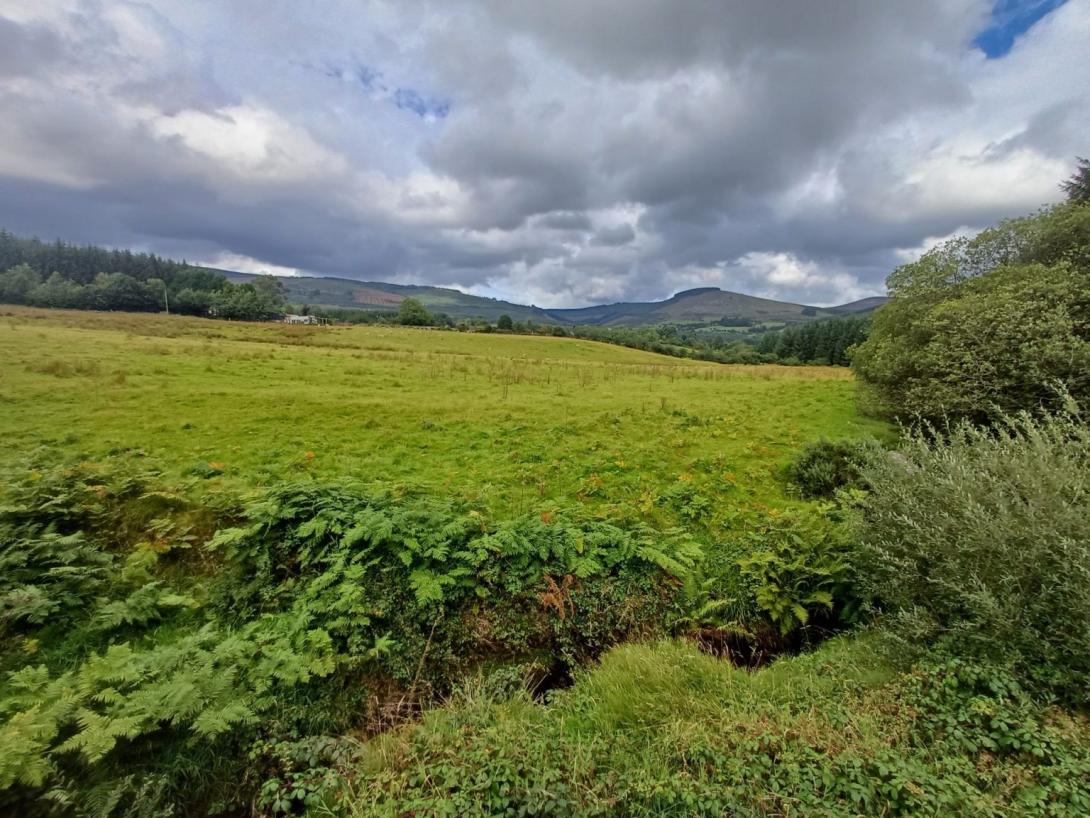
The Aughrim sub-catchment is part of the larger Avoca catchment, one of Ireland’s least-altered river systems. It flows from upland areas, through a farmed landscape, and into urban centers. But like many places, it’s under pressure due to land management that is impacting on water quality. Threats include overgrazing and afforestation in the uplands, urban runoff that ends up to the river, intensification of farming as well as modification of channels. On top of all that there has been a 7% increase in rainfall over recent decades.
Project's objectives
The six objectives of the project are:
1. Update and expand the previous assessment of wetland sites in the sub-catchments.
2. Conduct a comprehensive scoping assessment of the sub-catchments to map ongoing initiatives, identify gaps, and highlight opportunities for sponge measures.
3. Develop a sponge strategy and action plan for the sub-catchments, incorporating key findings.
4. Implement a work plan including pilot demonstration sites with selected landowners in the sub-catchment to trial and refine sponge measures.
5. Engage the urban community in Aughrim as a Sponge Community and implement urban sponge measures.
6. Disseminate project outcomes widely, promoting knowledge transfer across sectors and communities.
7. Create a pathway for delivery of sponge measures more widely beyond the study area.
1. Update and expand the previous assessment of wetland sites in the sub-catchments.
2. Conduct a comprehensive scoping assessment of the sub-catchments to map ongoing initiatives, identify gaps, and highlight opportunities for sponge measures.
3. Develop a sponge strategy and action plan for the sub-catchments, incorporating key findings.
4. Implement a work plan including pilot demonstration sites with selected landowners in the sub-catchment to trial and refine sponge measures.
5. Engage the urban community in Aughrim as a Sponge Community and implement urban sponge measures.
6. Disseminate project outcomes widely, promoting knowledge transfer across sectors and communities.
7. Create a pathway for delivery of sponge measures more widely beyond the study area.
Involved Partners
| Authority type | Authority name | Role | Comments |
|---|---|---|---|
Financing authorities
Community involvment
No
Design consultation activity
| Activity stage | Name | Key issues | Comments |
|---|---|---|---|
Policy target
| Target purpose |
|---|
Policy pressure
| Pressure directive | Relevant pressure |
|---|---|
Policy impact
| Impact directive | Relevant impact |
|---|---|
Requirement directive
| Requirement directive | Specification |
|---|---|
Contractual arrangements
0
| Arrangement type | Responsibility | Role | Name | Comments |
|---|---|---|---|---|
Part of wider plan
0
Wider plan type
| Wider plan type | Wider plan focus | Name | Comments |
|---|---|---|---|
Success factor(s)
| Success factor type | Success factor role | Comments | Order |
|---|---|---|---|
Driver
| Driver type | Driver role | Comments | Order |
|---|---|---|---|
English