Authors
Timillero, G. & Schaldach, R.
Publisher
RUVIVAL Publication Series
Year
2017
Abstract
Agroforestry is the inclusion of trees or other woody perennial plants into agricultural systems, including crop and livestock production. It can also be seen as a combination of agriculture and forestry. While conventional large scale agriculture is mainly concerned with maximising short term yields, agroforestry has the objective of emulating natural ecosystems in order to realise a number of ecosystem services. Those include the protection of soil against erosion and water-logging, minimising evaporation of water from soil and plants by decreasing wind speed, water protection through deeper and more extensive root systems and increased biodiversity. Long term stability and productivity of agroforestry systems surpasses those of conventional monocultures or pasturelands, as they tend to be more resilient, but the establishment of trees on farmland comes with certain challenges. Until the trees start to pay off, several years or even decades might pass. The right combination of trees, crops and animals for the particular climate, soil type and desired outcomes has to be carefully selected, which is often hard to predict in terms of productivity and required management. Trees have the potential to become too dominant and diminish yields of nearby cash crops or pasture grasses. Moreover, agricultural policies still tend to favour large scale conventional farming methods over alternative land management systems by selective provision of subsidies and lack of regulatory framework concerning agroforestry systems in particular.
NWRM(s)
Authors
Theofanidis, A., Kastridis, A. & Sapountzis, M.
Publisher
land
Year
2025
Abstract
This study examines the effectiveness of torrential erosion control structures (concrete check dams) to mitigate post-fire sediment transport within the Seich Sou Forest in Thessaloniki, Greece. Four years after the fire of 1997, which burned 68% of the forest, check dams were constructed (in 2001) to control erosion and sediment transport in the catchments of Eleonas and Panteleimon. In 2022, our team conducted field surveys, in which the size, effective storage capacity, and siltation of 40 check dams were recorded. The results revealed that the dams stored 14.36% and 18.81% of their total effective capacity in the Eleonas and Panteleimon catchments, respectively, with average annual erosion levels of 0.33 t/ha/year and 0.21 t/ha/year. These low rates of erosion could be attributed to the shallow, rocky soils and rapid post-fire vegetation recovery. However, this study highlights that timely construction of check dams immediately after the fire could have significantly increased their effectiveness. The results showed that if the dams were constructed immediately after the fire, they would retain 6.17 t/ha/year (Eleonas) and 7.08 t/ha/year (Panteleimon), during the first three post-fire years. These values of erosion are in agreement with previously published studies in Mediterranean ecosystems. This study highlighted the importance of the timely construction of post-fire erosion control structures to increase sediment storage and reduce soil transportation.
NWRM(s)
Authors
Stauffer, B., Carle, N. & Spuhler, D
Publisher
Sustainable Sanitation and Water Management
Year
2012
Abstract
Gully plugs, also called check dams, are mainly built to prevent erosion and to settle sediments and pollutants. Furthermore, it is possible to keep soil moisture due to infiltration. Depending on the topography, amount of precipitation, material and financial resources available, there are several methods to construct a gully plug. They have to be inspected regularly and any damages must be repaired.
NWRM(s)
Source type
Website
Authors
Marchi, L., Comiti, F., Crema, S. & Cavalli, M.
Publisher
Science of the Total Environment
Year
2019
Abstract
The need for reducing erosion and sediment transport, and protecting human settlements has urged the construction of channel control works in mountain streams. Such works include different structures, the check dams being probably the most widespread and archetypical. The performance of channel control works in mountain streams has usually been evaluated based on their effectiveness in stabilizing the channels and the adjacent hillslopes, and in retaining sediment. The widespread presence of channel control works in mountain streams of various regions, however, has also a significant impact on hillslope-channel coupling and on sediment transfer across the channel system. Taking into account the impact of channel control works on sediment connectivity at the catchment scale has remarkable importance for planning new control structures and managing the existing ones and, more in general, for sediment management in mountain catchments. In this paper, we consider the channel control works within the conceptual framework of sediment connectivity and related terminology, and we analyze the spatial and temporal scales of the interactions between channel control works and sediment coupling-decoupling. Some examples from the Italian Alps outline the impact of check dams and other hydraulic structures on sediment connectivity and show the potential of geomorphometry in assessing such impacts. The overall effect of control works on sediment connectivity consists of an alteration of the sediment cascade with a decrease in the efficiency of sediment transfer. Sediment is partly retained behind grade-control dams within the catchment or in sediment traps equipped with retention check dams near the alluvial fan apex. These works contribute to decouple the alluvial fans from the upslope catchment. On the contrary, channel bed lining on alluvial fans favors sediment transfer to the receiving river, but this effect usually involves small amounts of sediment not retained by the check dams built upstream.
NWRM(s)
Source type
Scientific Article
Authors
Lucas-Borja, M.E., Piton, G., Yu, Y., Castillo, C. & Zema, D.A.
Publisher
CATENA
Year
2021
Abstract
Check dams have been used throughout the world for a variety of purposes including torrent control, water supply enhancement, agricultural land development, and watershed restoration. National, regional and local governments have invested, and continue to invest, in basin scale erosion-control projects that may include both maintenance of existing and construction of new check dams. The functions of these structures are diverse and vary depending on the geomorphic context where the structures are built. However, although the number of check dams constructed to control floods, regulate sediment transport, reduce upstream reach slopes and stabilize torrent beds continues to increase, some projects have experienced disappointing results, and thus project objectives are not achieved. Causes of failure include poor construction quality, inadequate check dam location and lack of adequate design criteria. These failures lead to reduced confidence in using check dams as restoration tools. Moreover, both construction of dense networks of check dams and construction of a few large open structures require major economic investments, however a comprehensive evaluation of their long-term effectiveness is still lacking. This review aims to achieve a detailed synthesis of the effects of check dams based on a review of the literature that includes conceptual thinking, field observations and numerical approaches. Using the knowledge gaps identified in this work as a starting point, the review is an effort to join and share scientific and technical information from a variety of sites throughout the world based on the legacy effects of check dams. The role of complex interactions between ecological impacts, geomorphic processes and engineering activities is also highlighted. Overall, this review identifies the self-similar character of check dams and the process feedback loops they initiate across a range of spatial scales and geographic settings.
NWRM(s)
Authors
Castillo, V.M., Mosch, W.M., Conesa García, C., Barberá, G.G., Navarro Cano, J.A. & López-Bermúdez, F
Publisher
CATENA
Year
2007
Abstract
The construction of transverse structures (check dams) is a widely used method in Spanish Mediterranean areas to stabilise gullies and ephemeral streams, to reduce channel incision and to prevent sediment deposition downstream. The effectiveness of check dams and their effects on the morphology of ephemeral channels (ramblas) were investigated in a semiarid, highly degraded catchment. In the study area, 36 dams were surveyed, of which 29 were filled up with sediments, 2 had been destroyed and only 5 had still not completely filled with sediments. The streams above the dams held sediments, which resulted in a decrease in the longitudinal gradient. Field observations of changes in the cross-sectional shape of the stream channel, the composition of channel bed material, and bankfull stage measurements indicated that the dams cause erosion downstream. The amount of sediments stored by the dams was found to be higher than the amount of eroded material in the downstream reaches of the dam.
NWRM(s)
Source type
Scientific Article
Authors
Bombino, G., Barbaro, G., D'Agostino, D., Denisi, P., Foti, G., Labate, A., Zimbone S.M.
Publisher
CATENA
Year
2022
Abstract
Currently, most of the world’s coastal territories are subject to erosive processes, often caused by an alteration of sediment balance due to both natural and anthropogenic factors. This issue is relevant in many Mediterranean territories such as Calabria region, in southern Italy. Here, considerable anthropogenic pressures affect about 750 km of coast on which debouch short torrential rivers locally termed ‘fiumare’. The regional climate, hydrology and geomorphology leads to intensive fiumare catchment erosion and high fluvial solid loads.
The work focuses on the Gallico fiumara, chosen as case study affected by an intense hydraulic regulation programme in order to investigate the poorly studied effects of engineering control works on shoreline changes.
The paper has considered the effects of the 264 check dams (completely filled a few years after their realization) only investigating the relationships between the volume retained by the structures and shoreline change during the several arrangement campaigns. Although the work does not consider the other processes that explain the complexity of the watershed-coast sediment balance, it has been clearly demonstrated an influence of check dam system on the evolution of the shoreline, especially due to the hydraulic works installed in the lower part of the watershed. In the light of the results obtained, it would be desirable to promote a debate on the opportunity to convert or demolish the check dams in the torrent reaches closest to the coast, where, moreover, the engineering control most reduced the already limited natural riverbed slope.
NWRM(s)
Source type
Scientific Article
Authors
Bombino, G., Tamburino, V. & Zimbone, S.M.
Publisher
Ecological Engineering
Year
2006
Abstract
The paper illustrates some criteria for the assessment of the direct effects of check-dams on riparian vegetation. The paper develops a methodology to investigate such effects, which requires the preliminary identification of homogeneous torrent reaches in which a sample of existing check-dams is identified for study. Transects, subdivided into sample areas, are located immediately upstream and downstream of check-dams and in control zones. At these transects vegetation parameters (number of species, canopy cover of each species and vegetation layer, height of each vegetation layers, vegetation type, biological forms and ecological groups) are surveyed. Two new parameters (global canopy cover and weighted canopy height) are proposed to give synthetic information on the global development of vegetation. The features of transects close to check-dams are compared with those of control transects. The methodology is applied to two calabrian torrents. An influence of check-dams is found especially in the lower torrent reaches, with a longitudinal diversification of vegetation types and the creation, either immediately up or downstream, of habitats characterized by new biological and ecological formations.
NWRM(s)
Source type
Scientific Article
Code
N16
Sector
Hydro Morphology
Year of Issue
2025
Other sector(s)
Agriculture
Forest
Summary

Check dams, also referred to as gully plugs, are transverse structures constructed across channels, gullies, torrents, or ephemeral streams with the purpose of reducing water flow velocity, controlling erosion, and promoting sediment deposition. In addition to their core hydraulic function, they are often employed in arid and semiarid regions to facilitate managed aquifer recharge and to create shallow upstream...


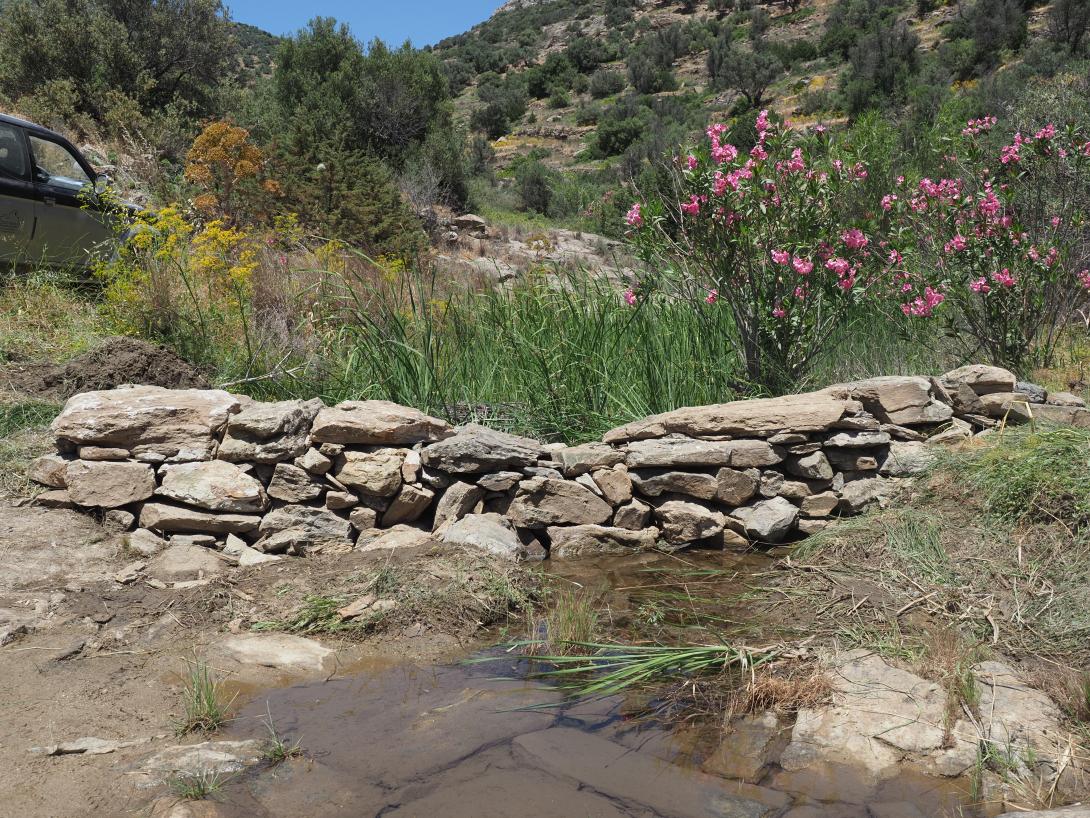
Illustration: Stone check dam (GR)

Source: SpongeScapes project

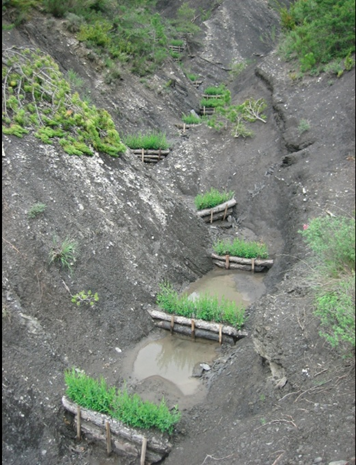
Illustration: Woody Check dam (FR)

Source: Europe Geosciences Union 


Possible benefits with level
Benefits Level
Slowing and reducing runoff
High
BP1 - Store runoff
High
BP2 - Slow runoff
High
BP3 - Store river water
Low
BP4 - Slow river water
High
BP5 - Increase evapotranspiration
Low
BP6 - Increase infiltration and/or groundwater recharge
Medium
BP7 - Increase soil water retention
Low
BP8 - Reduce pollutant sources
High
BP9 - Intercept pollution pathways
High
BP10 - Reduce erosion and/or sediment delivery
High
BP11 - Improve soils
Low
BP12 - Create aquatic habitat
Medium
BP13 - Create riparian habitat
High
BP14 - Create terrestrial habitats
Medium
BP17 - Absorb and/or retain CO2
Medium
ES1 - Water storage
Medium
ES2 - Fish stocks and recruiting
Medium
ES3 - Natural biomass production
Low
ES4 - Biodiversity preservation
Medium
ES5 - Climate change adaptation and mitigation
Low
ES6 - Groundwater/aquifer recharge
Medium
ES7 - Flood risk reduction
High
ES8 - Erosion/sediment control
High
ES9 - Filtration of pollutants
High
ES10 - Recreational opportunities
Low
ES11 - Aesthetic/cultural value
Low
PO1 - Improving status of biology quality elements
Low
PO2 - Improving status of physico-chemical quality elements
Low
PO3 - Improving status of hydromorphology quality elements
Low
PO4 - Improving chemical status and priority substances
Low
PO5 - Improving quantitative status
Low
PO6 - Improving chemical status
PO7 - Prevent surface water status deterioration
Medium
PO9 - Take adequate and co-ordinated measures to reduce flood risks
PO10 - Protection of important habitats
Medium
PO11 - Better protection for ecosystems and more use of Green Infrastructure
Medium
PO12 - More sustainable agriculture and forestry
Medium
Medium
PO14 - Prevention of biodiversity loss
Medium
ES13 - Geological resources
Low
Authors
Klara Kerpely
Publisher
WOCAT
Year
2022
Abstract
Leaky woody dams are natural flood management structures constructed from logs and branches, designed to mitigate peak flow velocities and volumes in catchment areas. These structures permit low water flows to pass through while impeding high flows, thereby providing temporary water storage and enhancing infiltration. Typically elevated 30 cm above the streambed, leaky dams allow baseflow and aquatic life to continue unimpeded. Commonly applied in hilly, forested regions, they serve as a sustainable solution to reduce flood risks and improve water management.
Source type
Project Report