- Bioswales
- Wadis
- Grassed waterways
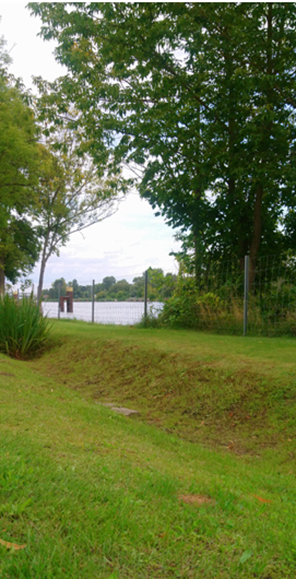
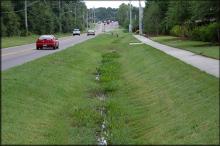
Swales are broad, shallow, linear vegetated channels which can store or convey surface water (reducing the rate and volume of runoff) and remove pollutants. They can be used as conveyance features to pass the runoff to the next stage of the SuDS treatment train and can be designed to promote infiltration where soil and groundwater conditions allow. Three types of swales provide different surface water management capabilities:
Standard conveyance swale – Generally used to convey runoff from the drainage catchment to another stage of a SuDS train. They may be lined or un-lined, depending on the suitability for infiltration.
Enhanced dry swale – Includes an underdrain filter bed of soil below the vegetated conveyance channel to accommodate extra treatment and conveyance capacity above that of the standard swale. The underdrain leaves the main channel dry except during larger runoff events, and will prevent channels becoming waterlogged where the swale is situated on gentler slopes. A lining can also be incorporated into the underdrain if infiltration to underlying ground is not appropriate.
Wet swale - Where prolonged treatment processes are required for the storm runoff, the swale’s conveyance channel can be encouraged to maintain boggy conditions by using liners to control infiltration, or by being located in an area of high water table.
Sedimentation is enhanced by the use of dense vegetation, usually grass, which promotes low flow velocities to trap particulate pollutants. In addition, check dams or berms can be installed across the swale channel to promote sedimentation and infiltration. As a result, swales are effective in improving water quality of runoff, by removing sediment and particulate pollutants. In wet swales, the effectiveness is further enhanced by providing permanent wetland conditions on the base of the swale.
Swales can be used in a wide range of situations. They are typically located next to roads, where they replace conventional gullies and drainage pipe systems, but examples can also be seen of swales being located in landscaped areas, adjacent to car parks, alongside fields, and in other open spaces. They are ideal for use as drainage systems on industrial sites as any pollution that occurs is visible and can be dealt with before it causes damage to the receiving water.